
 AS 1720.1 (NZS AS 1720.1:2022 in New Zealand)
 Design Red Stag CLT to AS 1720.1
Red Stag CLT is integrated in SPEC Toolbox with 108 panel layups drawn from the platform database, covering 3 to 11 layers and total thicknesses from 104 to 425 mm in New Zealand radiata pine. Declared stiffness and strength values come from the Red Stag CLT Design Guide V1.5 of September 2024, with longitudinal layers at 8.0 to 11.99 GPa and transverse layers at 6.0 to 7.99 GPa. Panel verification follows AS 1720.1, and NZS AS 1720.1:2022 in New Zealand.
Start Designing for Free Back to Red Stag Red Stag CLT Design Guide V1.5, September 2024


The engineer's guide
Designing Red Stag CLT to AS 1720.1
ASH MASSLAM glulam is integrated in SPEC Toolbox for design to AS 1720.1. Four grades are live in the platform database: MASSLAM SL33 and SL35 on widths of 65 to 140 mm, and MASSLAM 38 and MASSLAM 45 on widths of 120 to 450 mm, with depths from 120 mm to 1250 mm. Laminations are Plantation Oak and Australian Oak from the Heyfield factory in Victoria. The member design modules read the integrated section and grade set directly.
Australian Sustainable Hardwoods (ASH) makes the MASSLAM range at Heyfield in Victoria, has produced glue laminated timber since 1996, and now runs more than 100 cubic metres a day. ASH processes its own Plantation Oak, Australian Oak and Glacial Oak feedstock across two Heyfield sites, from log to finished component.
Product range
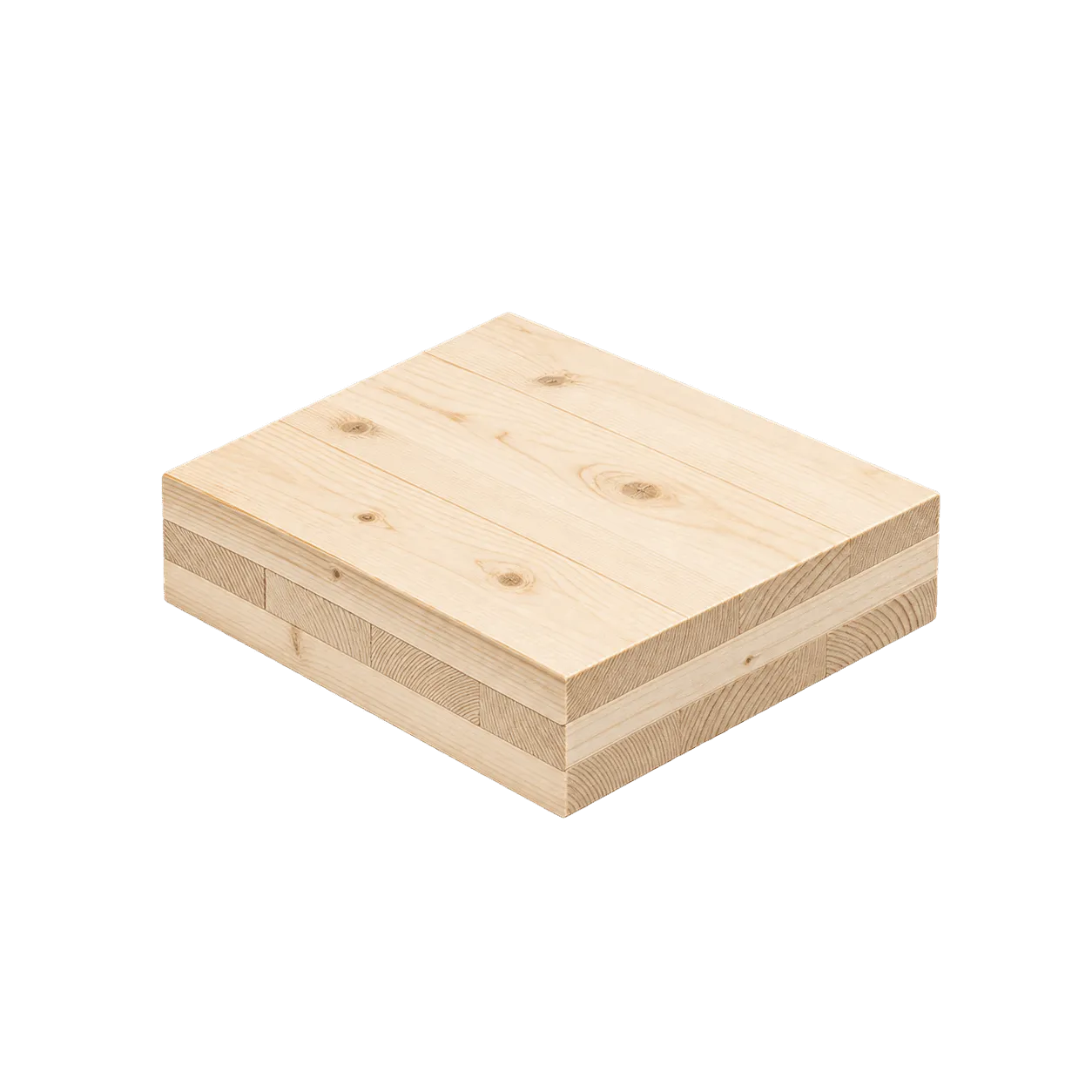
Red Stag manufactures cross laminated timber at its Rotorua plant from New Zealand grown radiata pine, certified to FSC under licence code FSC-C172039. The platform database carries 108 integrated layups covering 3 to 11 layers, including even-layer builds, with total thicknesses from 104 to 425 mm. Layups follow a CL[layers]/[thickness] label, and most geometries come in two grade variants: (a) with MoE 8 GPa longitudinal layers and (b) with MoE 10 GPa, both over MoE 6 GPa transverse layers.
Lamellae are produced at 42, 20 and 45 mm finished thickness. Layers are not edge glued, so a small gap can remain between boards. Lamellae are finger jointed across the face with a visible 7 mm finger, and both the finger joints and the layer bond use a polyurethane reactive (PUR) adhesive.
Billets are produced up to 16.5 m long, 4.5 m wide and 0.42 m deep. Panels come in a standard non-visual grade and in visual grades F1, F2 and All, with filling and sanding by prior agreement, and can be CNC machined with angled cuts. Overall thickness tolerance is the greater of plus or minus 2 mm or 0.4 mm per layer. Chain of custody is FSC and an Environmental Product Declaration is available.
Compatibility
Load-bearing walls, floors and roofs, plus lift shaft walls and stair panels. Exposure is set by the treatment specified rather than by a service class: H1.2 boron for protected interior use, H3.2 CCA where moisture exposure is higher. Surfaces run from standard non-visual to visual F1, F2 and All, with CNC machining and angled cuts.
What's distinctive
- Declared values from Design Guide V1.5: longitudinal laminates at 8.0 to 9.99 GPa or 10.0 to 11.99 GPa over transverse laminates at 6.0 to 7.99 GPa, bending strength of 14 MPa and 20 MPa for the two longitudinal bands, and normal shear of 3.8 MPa.
- Rolling shear testing with Scion found a lamella width to thickness ratio of 2:1 still exceeded 1.6 MPa, above Red Stag’s own design criterion.
- Large scale furnace testing by BRANZ recorded no structural, integrity or instability failure after more than 60 minutes at 900 degrees Celsius.
- Panels are supplied preservative treated as standard, to a minimum of H1.2 boron under NZS 3640:2003, with a clear boron option that does not tint a visual grade face.
In the platform
Red Stag panels run across the SPEC Toolbox CLT modules: CLT floor, CLT wall, CLT shear wall, CLT diaphragm and CLT floor penetration. They also appear in the screw connection module, the panel-to-panel connection details for spline, butt joint and half-lap, and the CLT floor-to-glulam beam, CLT floor-to-floor and CLT wall-to-wall connections.
Panel behaviour is taken from the integrated database using the exact declared values of the Design Guide. The same database values are used for design to the Australian and New Zealand standards. Fire design, vibration and other verifications not covered by the current Eurocode 5 can be checked against the new Eurocode 5 and other relevant documentation.
Design codes
There is currently no New Zealand or international structural design standard that specifically covers CLT, so the Design Guide states that the consulting engineer designs and certifies the panel as a performance solution. Member verification follows AS 1720.1, and NZS AS 1720.1:2022 in New Zealand; the Design Guide references NZS 3603:1993 and AS/NZS 1720.1:2022 for its declared strength properties, with actions to AS/NZS 1170. Its worked examples analyse panels by the shear analogy method, and its indicative span tables draw on the FPInnovations CLT design guide and AS/NZS 1170.0. Production quality assurance is documented against AS/NZS 1328.1 and Annex A of BS EN 16351:2021 for delamination, and AS 5068:2006 for finger joints. No ETA, ICC-ES ESR, BRANZ appraisal or CodeMark is held for the product.
More from this partner
Other Red Stag Integrations

Design With Red Stag
How current is the Red Stag CLT data in SPEC Toolbox?
The integrated layups sit in the SPEC Toolbox database and the declared values come from Design Guide V1.5, dated September 2024. The page is revised when a later Design Guide, certificate or appraisal is issued.
What if a project needs a layup that is not in the integrated list?
Red Stag can produce configurations beyond the standard recipes, though feedstock availability governs whether an alternate is viable and what it costs. Projects under 200 cubic metres are offered the priority recipes only unless agreed in advance.
Can Red Stag CLT panels span in two directions?
At least four layers are needed for two-way action. The Design Guide notes a four-layer symmetrical panel carries load equally in both directions at lower self weight than a five-layer panel, while asymmetrical panels are unequal.
Free, browser-based, no download. Design any certified connection into your real materials in seconds.
Start Designing For Free →Get your products in front of every engineer specifying on the platform — at the point of design.
Get Your Products Specified →
Get the latest updates, tools, and resources for smarter timber design—straight to your inbox.


© 2026 SPEC Toolbox.
Website by Sanatan