
 AS 1720.1
 Design Hyne Glulam to AS 1720.1
Hyne Timber manufactures glulam beams and columns at Maryborough, Queensland, from Australian plantation Southern Pine and Queensland hardwoods. SPEC Toolbox carries four Hyne grades, LGL44, GL13, GL15 and GL21, across 74 cross-sections from 44 to 130 mm wide and 120 to 525 mm deep. Members are manufactured and appearance graded to AS 1328.1-1998, and the characteristic values declared for each grade and held in the integrated database are used for member design to AS 1720.1. No European Technical Assessment applies.
Start Designing for Free Back to Hyne Timber AS 1328.1-1998; supplier size and specification sheets issued June 2025 (Beam 15) and July 2025 (Beam 21, LGL); GLT category brochure issued October 2025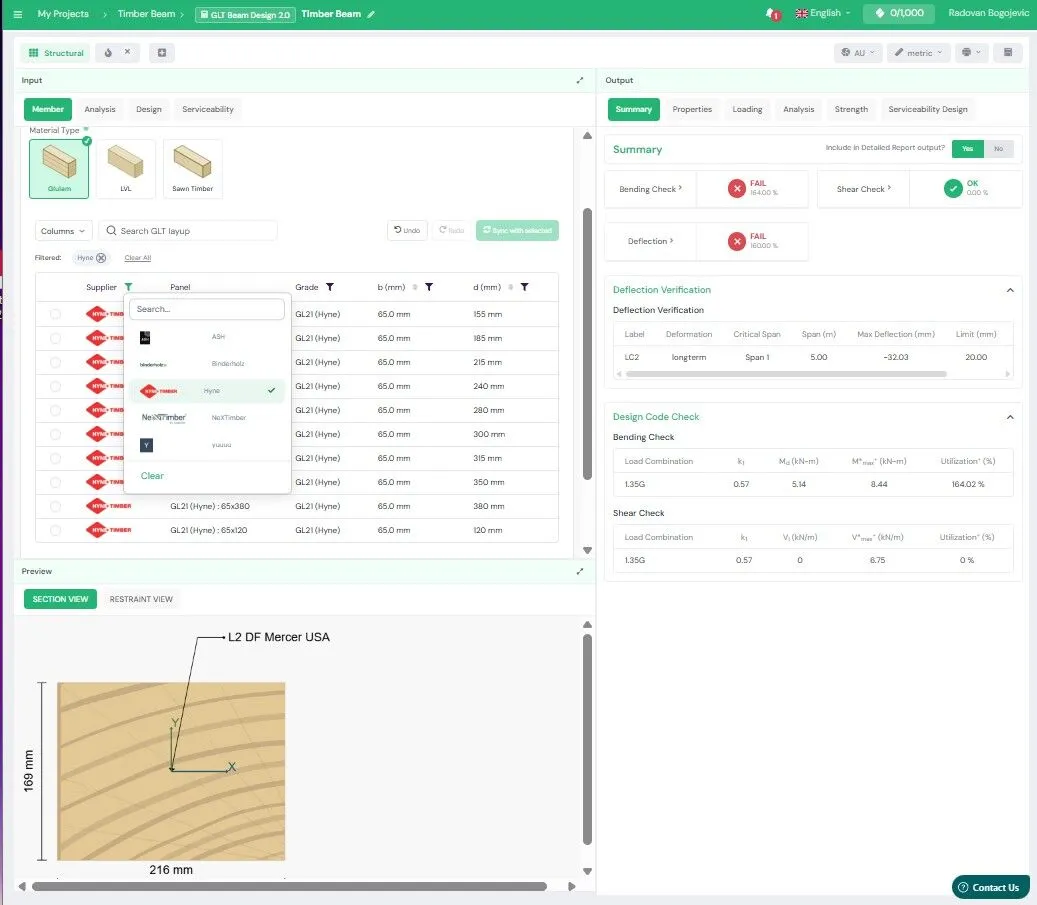


The engineer's guide
Design Hyne Glulam to AS 1720.1
Hyne Timber manufactures glulam beams and columns at Maryborough, Queensland, from Australian plantation Southern Pine and Queensland hardwoods. SPEC Toolbox carries four Hyne grades, LGL44, GL13, GL15 and GL21, across 74 cross-sections from 44 to 130 mm wide and 120 to 525 mm deep. Members are manufactured and appearance graded to AS 1328.1-1998, and the characteristic values declared for each grade and held in the integrated database are used for member design to AS 1720.1. No European Technical Assessment applies.
Product range
Four grades are integrated: LGL44, GL13, GL15 and GL21. LGL44, GL15 and GL21 are Hyne proprietary products. LGL44, GL13 and GL15 are made from Australian plantation grown Southern Pine. GL21 is made from spotted gum in appearance grade A and from mixed Queensland hardwoods in appearance grade B.
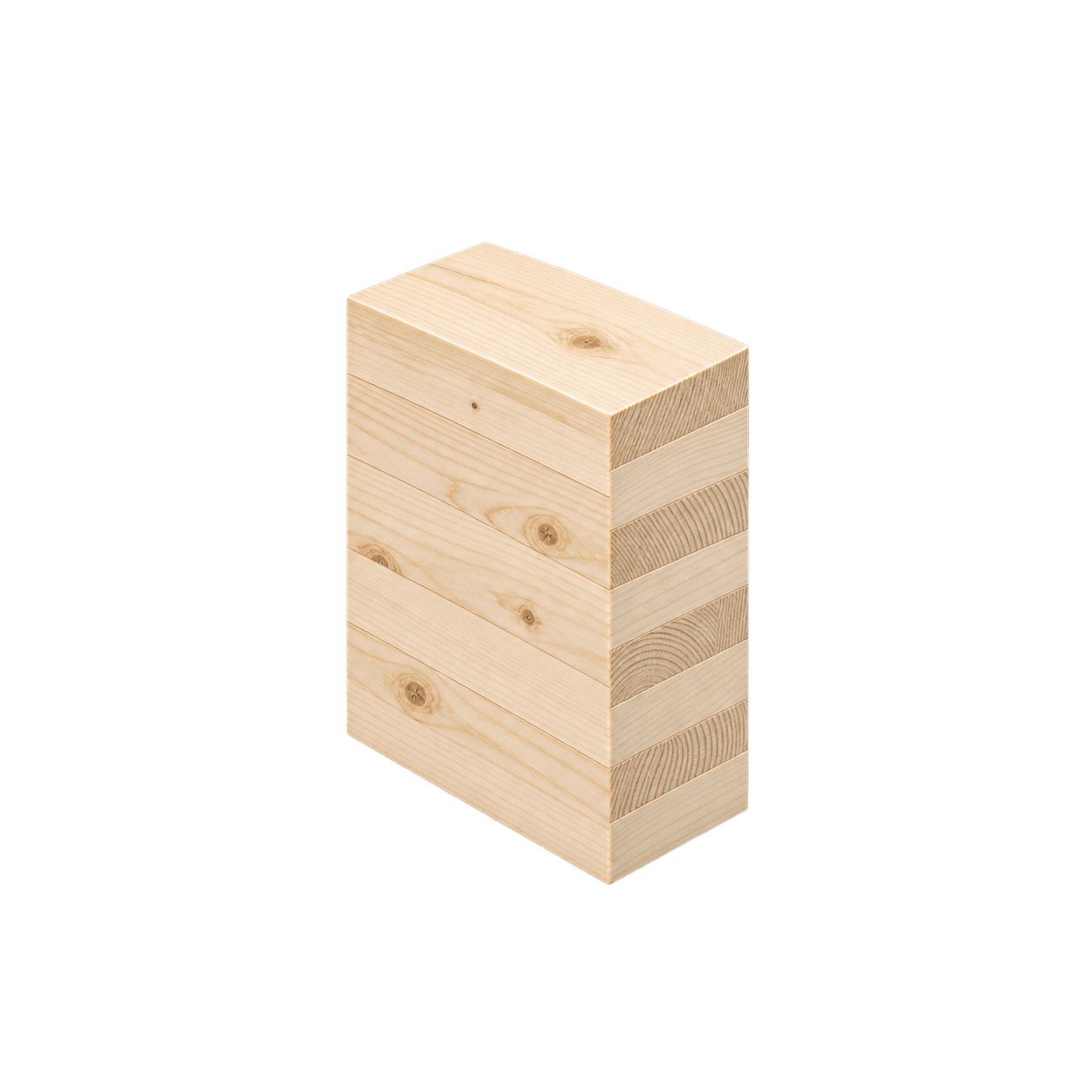
Lamella thickness is 20 mm in the LGL products and 35 mm in Beam 15 and Beam 21. The integrated range covers 74 cross-sections:
- LGL44: 44 mm wide, seven depths from 130 to 360 mm.
- GL13: 65 mm wide, seven depths from 130 to 360 mm.
- GL15: 65 mm wide to 495 mm deep, and 85 mm and 130 mm wide to 525 mm deep.
- GL21: 65 mm and 85 mm wide, eleven depths from 120 to 410 mm.
The largest integrated section is 130 mm wide by 525 mm deep, and depths to 1200 mm are made to order. Maximum production and transport length is 12 m. Block gluing is not offered. Beam 15 and Beam 21 are supplied straight or pre-cambered, and LGL is straight only. Appearance grades follow AS 1328.1-1998: grade A and grade B for GL15 and GL21, and grade C for LGL44 and GL13. Timber is sourced from PEFC certified Australian plantations with chain of custody certification. CNC machining, shop drawings and BIM content are available from the supplier.
Compatibility
Beams and columns, including lintels, rafters, bearers, posts, portal frames and long span members. The pine grades are specified H2 treated for internal above ground use and H3 treated for external above ground use. GL21 is durability class 2 above ground, with durability class 1 available on request. Sections can be CNC machined and supplied with bespoke profiles, and Beam 15 and Beam 21 can be pre-cambered to a 600 m radius.
What's distinctive
- GL21 is the only hardwood grade in the integrated Hyne range, declared at 50 MPa bending, 21 000 MPa modulus of elasticity, 1400 MPa modulus of rigidity and 1000 kg/m3 density, in joint group JD2 and strength group SD2.
- Three of the four integrated grades are Hyne proprietary products, so their design properties come from the supplier’s declared data rather than a published strength class.
- LGL44 and GL13 are cut from the same LGL product at 44 mm and 65 mm and carry different declared values: 30 against 33 MPa in bending, and 3.7 against 4.2 MPa in shear.
- Preservative treatment is a specification variable across the pine grades, with LGL produced from individually treated H3 laminates for indoor and outdoor use.
In the platform
Hyne glulam is available across the SPEC Toolbox member design modules: Timber beam, Timber column, Member design and Beam penetration. It is also available in the screw connection module and in the CLT floor to glulam beam connection.
Member behaviour is taken from the integrated database using the characteristic values declared for each Hyne grade. The same database values are used for design to the Australian and New Zealand standards. Fire design, vibration and other verifications not covered by the current design standard can be checked against other relevant documentation.
Design codes
Member design follows AS 1720.1. The members are manufactured and appearance graded to AS 1328.1-1998. Hyne glulam is an Australian product, so no European Technical Assessment applies and the members are not CE marked. The values used in design are those declared by the supplier for each grade and held in the integrated database: bending, tension, shear and compression strength, modulus of elasticity, modulus of rigidity, density, joint group and strength group. Charring rate, glue line fire integrity and an EPD are not recorded, so fire resistance and embodied carbon are not covered by the integrated values.
Design With Hyne Timber
How current is the Hyne data in SPEC Toolbox?
The integrated values are held against AS 1328.1-1998 and the supplier’s published specification sheets, issued June 2025 for Beam 15 and July 2025 for Beam 21 and LGL. When Hyne reissues a sheet, the grade and section data is rechecked against it and this page is updated.
Which Hyne glulam grades and sections are integrated?
Four grades, LGL44, GL13, GL15 and GL21, across 74 cross-sections. Widths are 44, 65, 85 and 130 mm and depths run from 120 to 525 mm. Deeper made to order sections up to 1200 mm are not part of the integrated list.
What can Hyne glulam be used for?
Beams and columns, including lintels, rafters, bearers, posts, portal frames and long span members. GL21 is used where a hardwood section with higher stiffness and density is wanted.
Free, browser-based, no download. Design any certified connection into your real materials in seconds.
Start Designing For Free →Get your products in front of every engineer specifying on the platform — at the point of design.
Get Your Products Specified →
Get the latest updates, tools, and resources for smarter timber design—straight to your inbox.


© 2026 SPEC Toolbox.
Website by Sanatan