 Eurocode 5 (EN 1995-1-1)
Design Eurotec Hangers to Eurocode 5
SPEC Toolbox designs Eurotec aluminium beam hangers to Eurocode 5 (EN 1995-1-1), using the characteristic load-carrying capacities of ETA-15/0761 (Magnus, Timberframe PRV and Connecto) and ETA-21/0710 (T-Tec), with the fastener checks of EN 1995-1-1 section 8. The integration covers face-fixed aluminium connectors for timber-to-timber connections, including joist-to-column, in solid timber, glulam, LVL and CLT, in service classes 1 to 3.
Start Designing for Free Back to Eurotec ETA-15/0761; ETA-21/0710 — ETA-15/0761 (issued 7 January 2026); ETA-21/0710 (issued 13 November 2025)

Eurotec (E.u.r.o.Tec GmbH, Hagen, Germany) has built fastening technology for timber construction since 1999, growing from a screw supplier into a manufacturer of wood construction screws, concrete fixings and connector systems. Its beam hangers are recognised under two European Technical Assessments, ETA-15/0761 (Magnus, Timberframe PRV and Connecto) and ETA-21/0710 (T-Tec). SPEC Toolbox designs the connectors to Eurocode 5, using the characteristic load-carrying capacities of those assessments.
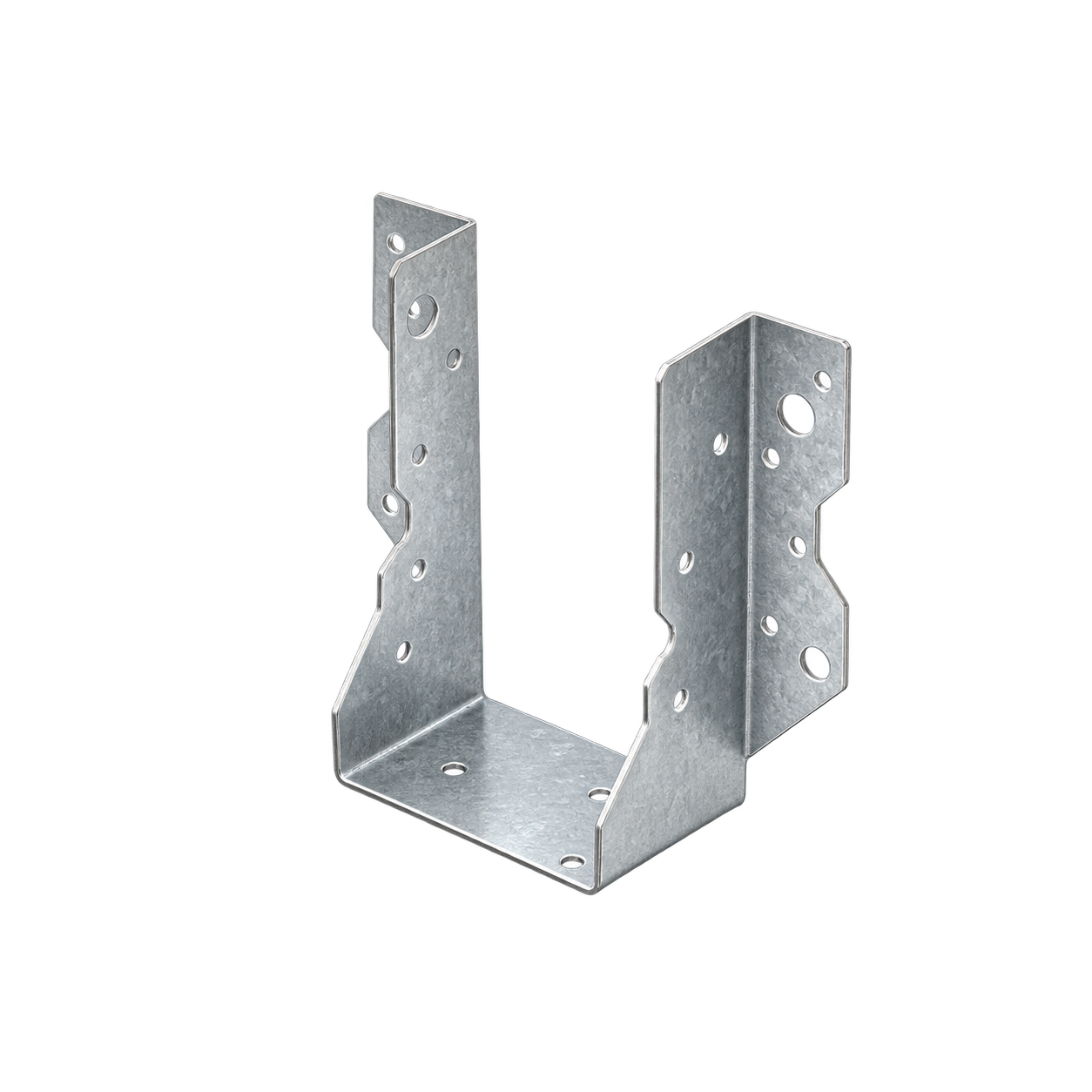
The integration follows the Eurotec hanger range as held in the platform, grouped by connector and by assessment. All are one or two-piece face-fixed aluminium connectors, classified Euroclass A1 for reaction to fire.
Two-piece beam hangers (ETA-15/0761)
One-piece connector (ETA-21/0710)
Magnus, Timberframe PRV and Connecto are fixed with Eurotec self-tapping screws to ETA-11/0024, with screws in all holes; the T-Tec takes screws or ringed-shank nails into the header and dowels through the joist.
At a glance, the Eurotec connectors support:
The Eurotec hangers are available in the hanger connection calculators, worked to Eurocode 5:
Capacities are selected for the connected members’ strength class and characteristic density, the connector size and the fastener set used, with the combined-force interaction applied where directions act together and end, edge and spacing requirements taken from the assessment and Eurocode 5. Timber-to-concrete and timber-to-steel connections, which the T-Tec is also assessed for, are not yet supported in the platform.
Design follows Eurocode 5 (EN 1995-1-1). The assessments give characteristic load-carrying capacities in each force direction, plus slip moduli for the connectors under ETA-15/0761, built from the Eurocode 5 expressions for a laterally loaded fastener against a thick steel plate and for screw withdrawal. The design capacity is the lesser of the timber-connection failure, with k_mod and the connection partial factor applied, and the metal-plate failure, with the aluminium partial factor per EN 1999-1-1. A characteristic density cap applies to the capacity formulas: 460 kg/m3 for Magnus, Connecto and T-Tec, 550 kg/m3 for Timberframe PRV, and a higher measured density may not be substituted. Where a header carries a connector on one side only, or on both sides with vertical forces differing by more than 20 percent, an eccentricity moment is verified on the header. Loading is static or quasi-static. Joint ductility and resistance to seismic actions are not assessed.
“We want to be more than a simple supplier, we want to be your reliable partner for your mass timber projects. We think SPEC Toolbox will push the boundary when it comes to making mass timber simply more accessible.”
— Jörn Rüschenschmidt, Head of Global Technical Advisory and Global Sales Manager for Timber Projects, Eurotec
It is written against ETA-15/0761, issued 7 January 2026, and ETA-21/0710, issued 13 November 2025. Values are re-checked against each assessment at its next issue before the integrated data changes.
Four: Magnus, Timberframe PRV and Connecto under ETA-15/0761, and the one-piece T-Tec under ETA-21/0710. Each is assessed; nothing is carried in addition to the assessments.
The T-Tec is assessed for timber-to-concrete and timber-to-steel connections, but those are not yet supported in the platform, and neither is a carried member set at an angle.
The connected members, including the eccentricity moment on a header loaded from one side, and the minimum timber cross-sections tabulated in the assessment, which must be increased where a fire-resistance rating governs. Corrosion protection is set by national provisions at the installation site, read with EN ISO 12944-2.
Free, browser-based, no download. Design any certified connection into your real materials in seconds.
Start Designing For Free →Get your products in front of every engineer specifying on the platform — at the point of design.
Get Your Products Specified →
Get the latest updates, tools, and resources for smarter timber design—straight to your inbox.

© 2026 SPEC Toolbox.
Website by Sanatan