

 Eurocode 5 (EN 1995-1-1, §8.7.2), editions 2004 and 2025
Design Simpson Strong-Tie Screws to Eurocode 5
Structural engineers use SPEC Toolbox to design the Simpson Strong-Tie ANZ screw range to Eurocode 5 (EN 1995-1-1, §8.7.2 for axially loaded screws), using characteristic values from ETA-13/0796, reissued 16 February 2022. The integration covers four assessed screw families in 8 and 10 mm, from 80 to 500 mm, for connections in solid timber, glulam, CLT and LVL and for compression and tension reinforcement perpendicular to the grain. Try the calculator to specify with confidence.
Start Designing for Free Back to Simpson Strong-Tie ETA-13/0796 · '16 February 2022 (replaces ETA-13/0796 of 15.12.2017)'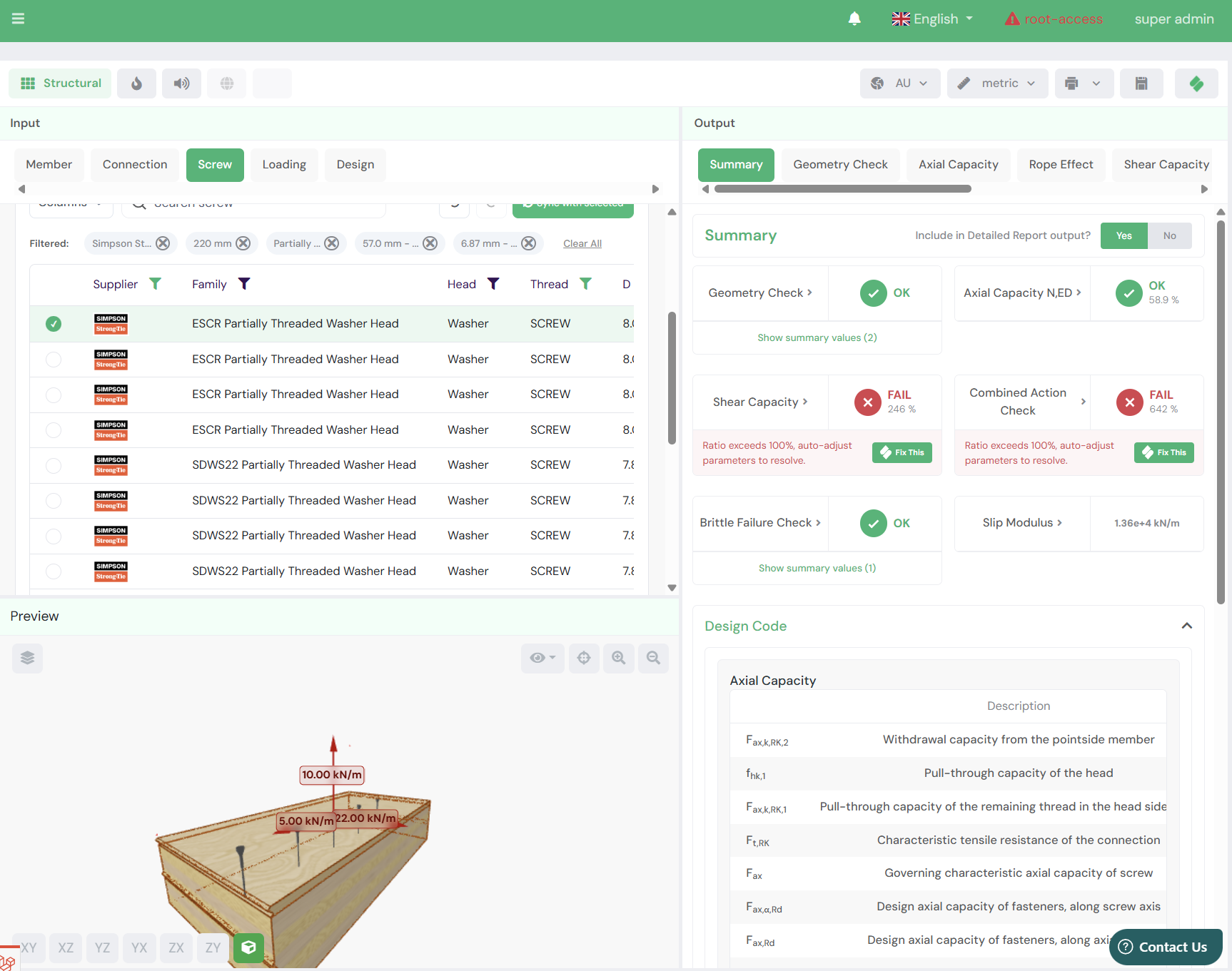


The engineer's guide
Designing Simpson Strong-Tie screws to Eurocode 5
Simpson Strong-Tie supplies structural solutions worldwide, with a portfolio spanning connectors, anchors and fasteners for timber, concrete and masonry construction, backed by in-house technical and design support. The ANZ screw integration is built on European Technical Assessment ETA-13/0796, reissued on 16 February 2022.
Product range
The ANZ integration carries seven screw families. Four are assessed under ETA-13/0796 and hold the characteristic data used for Eurocode 5 connection design:
- ESCR, washer head, partial thread, 8 mm, 80 to 320 mm.
- ESCRC, countersunk head, partial thread, 8 mm, 80 to 320 mm.
- ESCRFT, full thread, countersunk head in 8 and 10 mm, 180 to 350 mm, and cylinder head in 10 mm, 450 to 500 mm.
- ESCRFTZ, cylinder head, full thread, 8 mm, 120 to 400 mm.
All four are hardened or heat-treated carbon steel, yellow zinc plated, with a T40 six-lobe drive, in service classes 1 and 2. Characteristic design values are read from the database and applied at calculation time rather than interpolated, so no per-article numbers are printed here.
Three further families sit in the ANZ database outside that assessment: SDWS22 (washer head, 7.8 mm), which the integrated data links to Declaration of Performance DoP-h10/0017 under EN 14592; SDWS27 (flat head, 9.8 mm, 316 stainless steel); and SDWC (cylinder head, full thread, 6 mm). These are handled separately and are not part of the Eurocode 5 connection design set below.
Compatibility
The assessed families support:
- Solid timber, glued laminated timber, cross laminated timber and LVL.
- CLT face fixing and CLT edge fixing.
- Timber-to-steel connections.
- Insertion at an angle.
- Compression and tension reinforcement perpendicular to the grain, using the fully threaded ESCRFT and ESCRFTZ.
- Service classes 1 to 3.
What's distinctive
- Lateral capacity follows the screw-to-grain angle. Embedment strength carries the factor 2.5cos²α + sin²α on the angle between screw axis and grain, in both non-predrilled and predrilled members, so a screw driven at an angle is not designed on the perpendicular value.
- Cross laminated timber is treated as its own case. The edge surface has its own embedment expression, 20 divided by the square root of the outer thread diameter, independent of the screw-to-grain angle, and CLT carries its own plane-surface and edge-surface spacing sets for a minimum panel thickness of 10d.
- Spacing departs from the Eurocode 5 defaults in both directions. Laterally loaded screws follow the nail rules across the whole range, keyed to drill tip and pre-drilling rather than diameter, with minimum member thickness of 30 mm at 8 mm and 40 mm at 10 mm. For axially loaded screws a tighter set of a1 = 5d and a2 = 2.5d is allowed where a1·a2 is at least 25d², with the end distance to the centre of gravity of the threaded part at 5d rather than 10d.
- The rope effect is dropped under combined loading. Where a screw carries axial and lateral load together, the rope-effect contribution is left out of the lateral capacity entirely, against the 100 per cent of the Johansen part Eurocode 5 otherwise permits for screws.
In the platform
The screws assessed under ETA-13/0796 are available in:
- the Screw module;
- the connection detail calculators: panel-to-panel (half-lap, spline and butt joint), slab-to-wall, wall-to-wall, floor-to-wall;
- the rib-deck calculator, for flexible connection design to Eurocode 5.
The fully threaded ESCRFT and ESCRFTZ, which carry the reinforcement marking in the database, additionally appear in the reinforcement connection details: beam notch, beam penetration, and beam compression perpendicular to grain.
Design codes
Design follows EN 1995-1-1, with axially loaded screws verified to §8.7.2. The withdrawal expression of §8.7.2(4) applies to screws with an inner-to-outer thread ratio between 0.6 and 0.75, and the integrated diameters sit between 0.61 and 0.66. Both the 2004 and 2025 editions are supported. ETA-13/0796 supports CE marking. It is a European assessment and does not cover the AUS or NZ standards: the same product data is used for design in the AUS and NZ markets in accordance with the applicable design standards there.
More from this partner
Other Simpson Strong-Tie Integrations
Why Simpson Strong-Tie builds on SPEC
“Together, we are combining the world class testing and code compliance of Simpson Strong-Tie products with the intelligence and accessibility of SPEC Toolbox software, creating a seamless experience that helps engineers integrate our products directly into their mass timber designs.”
— Chris Crawford, Director, OEM and Mass Timber Market Segments, Simpson Strong-Tie
Design With Simpson Strong-Tie
How current is the Simpson Strong-Tie data in SPEC Toolbox?
It is written against ETA-13/0796 of 16 February 2022, which replaced the issue of 15 December 2017. A reissue sets the next review point, and values are re-checked against the new version before the integrated data changes.
Can a Simpson Strong-Tie screw be designed into another supplier's CLT or glulam?
Yes. The screw takes its characteristic values from ETA-13/0796, while the timber side is governed by the panel or member’s own strength and density, so it can be paired with any integrated CLT, glulam or LVL supplier in the same connection.
Are all Simpson Strong-Tie screws part of the ANZ integration?
The Eurocode 5 connection design set is the four families assessed under ETA-13/0796 at 8 and 10 mm. The assessment covers further screw types, among them ESCRS, ESCRFTC and SSTA, and diameters from 4 to 16 mm, which are not integrated. The SDWS and SDWC lines sit outside that assessment and are handled separately.
Free, browser-based, no download. Design any certified connection into your real materials in seconds.
Start Designing For Free →Get your products in front of every engineer specifying on the platform — at the point of design.
Get Your Products Specified →
Get the latest updates, tools, and resources for smarter timber design—straight to your inbox.





© 2026 SPEC Toolbox.
Website by Sanatan