 Eurocode 5 (EN 1995-1-1, §8.7.2), editions 2004 and 2025
Design Bi-Mirth BM Quick Drill Screws to Eurocode 5
Structural engineers use SPEC Toolbox to design the Bi-Mirth BM Quick Drill screw range to Eurocode 5 (EN 1995-1-1, §8.7.2 for axially loaded screws), using characteristic values from ETA-12/0471, issued 7 July 2025. The integration covers the six assessed families, partially threaded, double threaded and full threaded, from 6 to 14 mm and up to 1500 mm, for connections in solid timber, glulam, CLT and softwood LVL, for steel to timber connections, and for compression and tension reinforcement perpendicular to the grain. Try the calculator to specify with confidence.
Start Designing for Free Back to Bi-Mirth ETA-12/0471 · 7 July 2025 (replaces the version of 16 October 2023)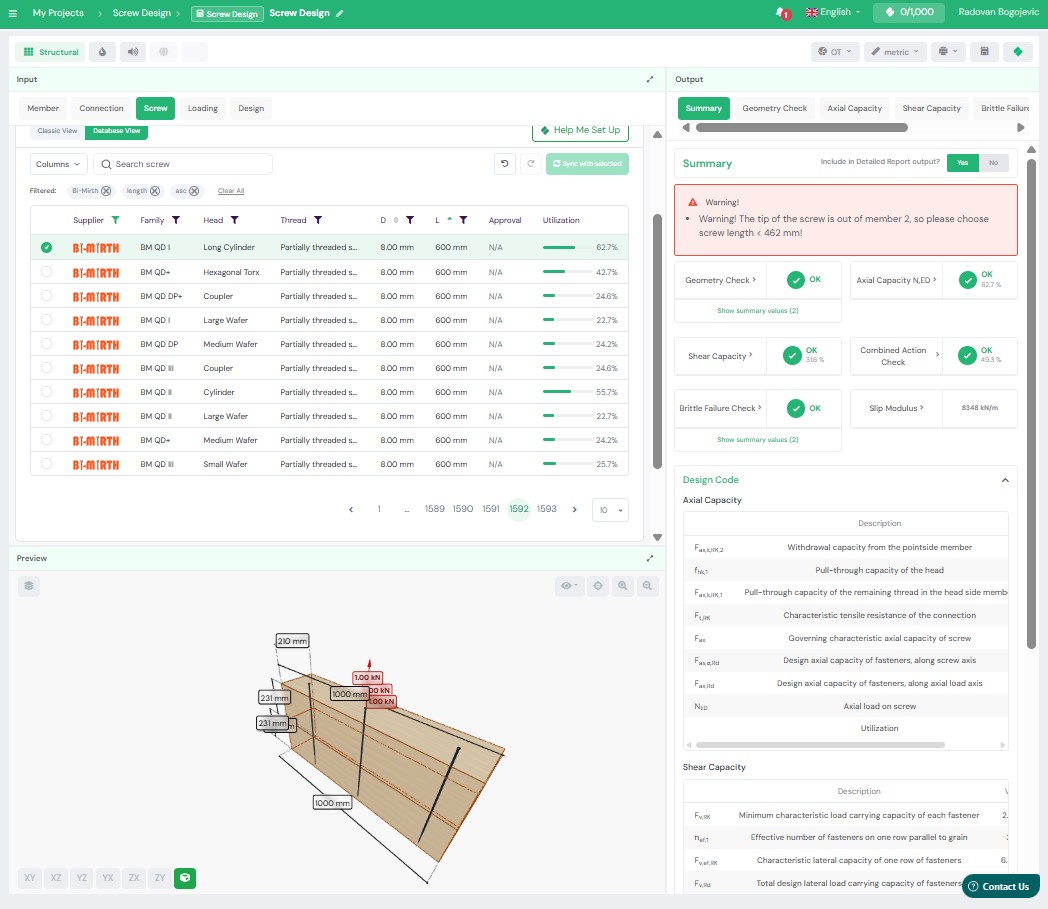


Designing Bi-Mirth screws to Eurocode 5
Bi-Mirth Corporation manufactures self-tapping timber construction screws at its plant in Taichung, Taiwan. The BM Quick Drill range is covered by European Technical Assessment ETA-12/0471, issued on 7 July 2025 under, replacing the version of 16 October 2023.
The integration presents the six BM Quick Drill families assessed under ETA-12/0471, grouped by thread type. Full characteristic design values are read from the Bi-Mirth database and applied at calculation time, not interpolated, so no per-article numbers are printed here.
Partial and full thread: BM Quick Drill, BM Quick Drill +, BM Quick Drill II, BM Quick Drill III
Double thread: BM DT Quick Drill
Full thread: BM FT Quick Drill
Six families are integrated for the region, spanning 6 to 14 mm and 40 to 1500 mm.
At a glance, the Bi-Mirth families support:
All Bi-Mirth screws are available in:
The screw families marked for reinforcement additionally appear in the reinforcement connection details: beam notch, beam penetration, and beam compression perpendicular to grain.
Design follows EN 1995-1-1, with axially loaded screws verified to §8.7.2. Two clause behaviours come from the assessment rather than the code defaults: under §8.7.1 the effective diameter is the outer thread diameter, in place of the default of 1.1 times the thread root diameter, and clause 8.7.2(1)P lists buckling under compression among the failure modes, which the assessment quantifies for the carbon steel full-thread screws through an ideal elastic buckling load on an elastic foundation.
It is written against ETA-12/0471 of 7 July 2025, which replaced the version issued on 16 October 2023. Values are re-checked against the certificate at its next reissue before the integrated data changes.
Yes. The screw’s characteristic values come from its ETA, while the timber side is governed by the member’s own strength and density, so a Bi-Mirth screw can be paired with any integrated CLT, glulam or LVL supplier.
The integration covers the six BM Quick Drill families from 6 mm diameter upwards. The assessment runs from 3.0 mm, so the smaller screws are out of scope, as is the fixing of thermal insulation on top of rafters.
ETA-12/0471 is a European assessment and does not cover the standards of other markets. The same product data is used for design in other markets in accordance with the applicable design standards there.
Free, browser-based, no download. Design any certified connection into your real materials in seconds.
Start Designing For Free →Get your products in front of every engineer specifying on the platform — at the point of design.
Get Your Products Specified →
Get the latest updates, tools, and resources for smarter timber design—straight to your inbox.

© 2026 SPEC Toolbox.
Website by Sanatan