 EN 1995-1-1
Design SPAX Screws to Eurocode 5
Structural engineers use SPEC Toolbox to design SPAX X-Series structural wood fasteners to the NDS (ANSI/AWC NDS) under the IBC and IRC, using the ASD and LRFD reference design values from ICC-ES ESR-5358 (issued March 2025). The integration covers the XF, XC, XS and XR series in 1/4 to 5/8 in. diameters, for wood-to-wood and steel-to-wood connections in sawn lumber, glulam, LVL, LSL and the face of CLT, in dry service.
Start Designing for Free Back to SPAX ETA-12/0114 (European Technical Assessment, ETA-Danmark)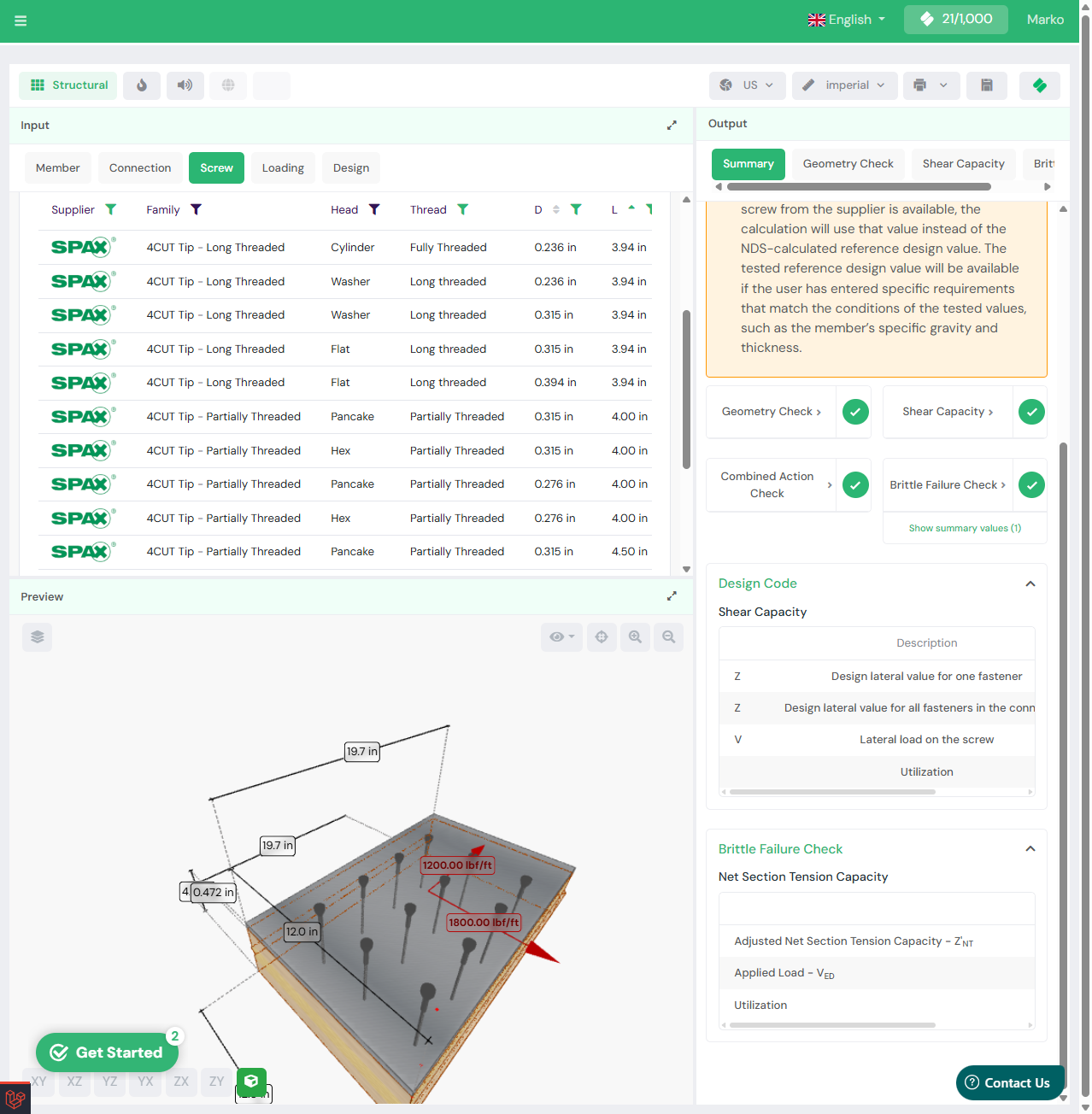


SPAX (SPAX International GmbH & Co. KG, Ennepetal, Germany) manufactures self-tapping screws and threaded rods for timber structures, assessed under European Technical Assessment ETA-12/0114 of 2020-01-07, issued by ETA-Danmark on the basis of EAD 130118-01-0603. SPEC Toolbox designs the connections to Eurocode 5, using the characteristic values declared in that assessment.
The integration covers the SPAX screws and threaded rods of the assessment, grouped by coating and material, in partially threaded, fully threaded and dual-threaded forms.
Zinc-coated carbon steel
Stainless steel
Threaded rods
The assessment covers screws of 2.5 to 12.0 mm (carbon steel) and 3.0 to 12.0 mm (stainless steel) in lengths from 20 to 1,000 mm, and threaded rods of 16.0 mm. Screws are supplied with the CUT and 4CUT drill tips and the T-STAR drive.
In the EU and ANZ scope the SPAX screws and threaded rods support:
The SPAX screws are available in the SPEC Toolbox screw connection module and in the connection detail calculators, worked to Eurocode 5:
Screw behaviour is taken from the integrated database with the characteristic values of ETA-12/0114 for the selected article, keyed to the connected member’s characteristic density, with the assessment’s minimum spacings, end and edge distances and penetration requirements applied. The same values are used for design to the Australian and New Zealand standards.
Design follows Eurocode 5 (EN 1995-1-1). The screws are assessed under ETA-12/0114, which supplies the characteristic values used in design: the tensile capacity (from 7.9 kN at 5 mm to 38 kN at 12 mm in carbon steel, and 63 kN for the 16 mm threaded rod), the yield moment (0.15 x 600 x d^2.6 Nmm for carbon steel and 0.15 x 400 x d^2.6 Nmm for stainless), the withdrawal parameter f_ax,k (14.0 N/mm2 below 6 mm, 12.0 N/mm2 from 6 to 8 mm, 11.5 N/mm2 at 10 mm and 11.0 N/mm2 at 12 mm) and the head pull-through parameter by head or washer diameter. Lateral capacity is calculated to Eurocode 5 using the outer thread diameter, with the assessment’s embedment strengths for non-pre-drilled and pre-drilled holes and for CLT, and the rope effect per Eurocode 5. Withdrawal is taken at angles from 15 degrees to the grain (30 degrees in LVL) with the effective number of screws, and inclined screws in shear connections use the assessment’s effective-number rule. Combined axial and lateral loading uses the quadratic interaction of Eurocode 5. Characteristic values are reduced to design values with the Eurocode load-duration and service factor and the material partial factor from the National Annex. Assessed service classes are 1 and 2 for zinc-coated screws and additionally 3 for stainless steel; the assumed working life is 50 years, and reaction to fire is class A1.
“Partnering with SPEC Toolbox was a no-brainer. Their clear focus on addressing the unique challenges of the mass timber industry positions them to overcome the critical limitations on access to education and design infrastructure.”
— Nicholas Benecke, Product Manager, SPAX International Timber Construction Solutions
The screws are assessed under ETA-12/0114 of 2020-01-07, which replaced the issue of 2017-10-12. The integrated values are re-checked against the assessment when it is next reissued, before the database changes.
The zinc-coated Wirox and Delta-Seal carbon steel screws and the stainless A2 (1.4567), A4 (1.4578) and HCR (1.4539) screws, in partially threaded, fully threaded and dual-threaded forms with countersunk, washer, cylinder and hexagon heads, from 5 to 12 mm diameter, together with the 16 mm threaded rods.
Connections in load-bearing timber structures between members of solid timber, glued laminated timber, cross-laminated timber, LVL and similar glued members in softwood and hardwood, and with wood-based panels or steel plates on the screw-head side. Zinc-coated screws are assessed for service classes 1 and 2; stainless screws additionally for service class 3.
Yes. Fully threaded screws and threaded rods are assessed as tensile or compressive reinforcement perpendicular to grain and as shear reinforcement in softwood members, with design rules for reinforced bearing areas, connections loaded perpendicular to grain, notched beam supports and holes in beams.
Screws are driven into softwood without pre-drilling or after pre-drilling; into hardwood, and threaded rods into softwood, after pre-drilling. Screws with the CUT or 4CUT drill tip may use the spacings given for pre-drilled holes without pre-drilling, provided the assessment’s member thickness and spacing conditions are met.
A dedicated embedment strength is declared for screws parallel to the plane of cross-laminated timber, and screws in the plane surface are designed as for solid timber using the characteristic density of the outer layer. The assessment gives separate minimum spacings, end and edge distances for the plane surface and the edge surface of CLT.
Free, browser-based, no download. Design any certified connection into your real materials in seconds.
Start Designing For Free →Get your products in front of every engineer specifying on the platform — at the point of design.
Get Your Products Specified →
Get the latest updates, tools, and resources for smarter timber design—straight to your inbox.

© 2026 SPEC Toolbox.
Website by Sanatan