
CLT Floor Design Calculator
A complete CLT floor verification to EN 1995-1-1, bending, shear, rolling shear, deflection and vibration. Three stiffness methods. ETA-backed supplier data. Free, browser-based, no download.
Start Designing Read The Guide
-
1,900 /moCLT floor calcs run
-
10 +EU CLT suppliers
-
3 methodsGamma · Ext. γ · Shear Analogy
-
100 % freeBrowser-based · no download
The calculator
Design your CLT floor now.
Partners
Suppliers integrated in this category
Pick their real layups and fasteners from inside the calculator above.


The engineer's guide
CLT Floor Design Under Eurocode 5
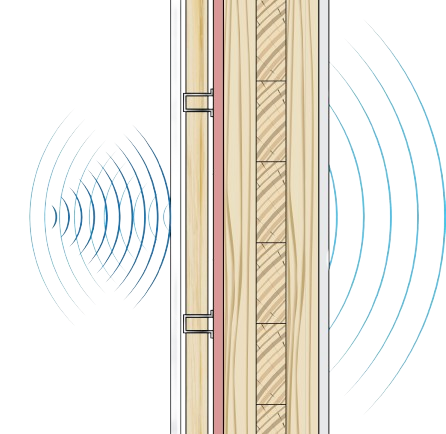
CLT floor design under Eurocode 5 is more nuanced than glulam or LVL because the cross-layers don’t carry bending — they only carry shear. That single fact governs almost every interesting decision you make on a CLT floor, from layup selection to vibration tuning. This guide covers the five checks the calculator runs, the three stiffness methods it supports, and the practical situations where each one matters.
What the calculator checks
Each calculation runs five independent checks against EN 1995-1-1, in both Ultimate Limit State (ULS) and Serviceability Limit State (SLS):
- Bending capacity (fm,Rd)
moment capacity of the longitudinal layers, per EN 1995-1-1 §6.1.6. Includes kmod, ksys, and γM factors. - Shear capacity (fv,Rd)
longitudinal shear strength of the panel, per EN 1995-1-1 §6.1.7. - Rolling shear (fr,k)
shear in the cross-layers. This is the “Achilles heel” of CLT and frequently governs short spans. Per EN 1995-1-1 §6.1.7(2) with manufacturer-specific characteristic values. - Deflection (winst, wfin)
both instantaneous and long-term creep deflection, applying kdef per service class. - Vibration (f1)
fundamental frequency, with f1 > 8 Hz typical for residential and office floors. The calculator implements the draft 2nd-generation Eurocode method including impulsive velocity response.
All five run on every calculation — you don’t have to switch modes. The verdict panel surfaces the governing check and the overall utilisation.
Three ways to model CLT stiffness
EN 1995-1-1 doesn’t mandate a single analytical method for CLT panels. The choice depends on the panel layup and how rigorous you need to be. SPEC supports three.
The Gamma Method
The classical approach from Annex B of EN 1995-1-1, valid for standard 3, 5 or 7-ply uniform panels. It accounts for rolling shear deformation in the cross-layers via a simplified efficiency factor (γ) and treats the panel as a single laminate with one effective bending stiffness.
Easy to verify by hand. Slightly conservative for thicker panels because it can’t model the rolling shear stiffness of each individual cross-layer separately.
The Extended Gamma Method (recommended default)
An extension of the standard Gamma method that accounts for the rolling shear stiffness of every individual cross-layer rather than treating the panel as a single laminate. This produces a more refined effective stiffness and prevents the overly conservative designs that the standard Gamma method gives for thick CLT (7-ply and above).
It’s the default in the calculator for good reason — on a typical residential or office span, the difference between Gamma and Extended Gamma can be the difference between specifying a 200mm and a 240mm panel.
The Shear Analogy Method
he most rigorous analytical approach, derived from Kreuzinger’s beam-on-elastic-foundation model. Treats the panel as a composite beam with distinct bending and shear stiffness components.
Use it for complex or asymmetric layups, panels with different grades in each layer, or any configuration where bending and shear stiffness can’t be assumed to act in parallel. Slower to evaluate but it’s the gold standard.
For most CLT floor projects, Extended Gamma is the right choice. If a panel is uniform and standard ply count, Gamma works. If the layup is asymmetric, switch to Shear Analogy.
Vibration usually governs
For mass timber floors, vibration is more often the governing serviceability limit than static deflection. The calculator runs the draft 2nd-generation Eurocode vibration method with options for stiff or flexible support modelling and performance-level targeting:
Composite action with a concrete topping significantly improves both frequency and impulsive response — the calculator handles bonded or mechanically connected toppings with user-defined thickness, modulus and connection stiffness.
How supplier data flows through
Every CLT panel option in the calculator pulls characteristic values directly from the manufacturer’s European Technical Assessment (ETA), not from generic catalogue numbers. Pick a supplier and the numbers match the product:
- Binderholz BBS — ETA-06/0009. Full layup range from BBS 60 to BBS 300.
- KLH BSP — ETA-06/0138. Standard and custom layups.
- XLAM Dolomiti L5s — ETA-22/0009. Including fire performance data shared with the CLT Fire calculator.
- Plus Kalvasta, MTT, Södra, Theurl, Hasslacher, Stora Enso and Mayr-Melnhof.
For unlisted manufacturers or research configurations, custom layup entry is fully supported — define layer thicknesses, grades and orientations manually and the calculator applies the standard Eurocode framework.
What’s News
Dive into our newest releases, articles, and tutorials designed to help you succeed.

Beam-to-Column Connection Design
CLT Floor design under Eurocode 5.
Which stiffness method should I use for a typical 5-ply CLT floor?
For uniform 3, 5 or 7-ply panels, the Gamma method is sufficient and easy to verify. For thicker panels (7-ply+) or non-uniform layups, Extended Gamma is recommended — it’s the default — because it gives less conservative outcomes by accounting for rolling shear stiffness in every cross-layer. For complex or asymmetric layups, use Shear Analogy.
Why is rolling shear so often the governing check?
Rolling shear (fr,k ≈ 0.7–1.1 N/mm²) is the weakest mechanism in CLT. On short spans where bending isn’t critical, the shear in cross-layers picks up the slack — and because cross-layer thickness is typically a third of total panel depth, stress concentration is high. The calculator always shows the rolling shear utilisation alongside the other checks so it can’t catch you out.
Can I model a concrete topping?
Yes — the calculator supports composite action with a concrete screed by accounting for the in-plane stiffness of the topping. Specify screed thickness, modulus and connection type (flexible/bonded or rigid/mechanical).
Can I export a calculation report?
Yes. A full PDF calculation report with all intermediate values, k-factors, safety factors, ETA references and inputs is available with a free SPEC account.
Free, browser-based, no download. Design any certified connection into your real materials in seconds.
See Calculators →Get your products in front of every engineer specifying on the platform — at the point of design.
Partner With Us →
Get the latest updates, tools, and resources for smarter timber design—straight to your inbox.





© 2026 SPEC Toolbox.
Website by Sanatan
 KLH Supplier
 Mercer
 Nordic Strucutres
 CLT
CLT Dowels
 Glulam
 Screws