Design Timber Brackets to AS 1720.1
Specify proprietary timber brackets, hold-downs and shear plates in Australia and New Zealand to AS 1720.1 using real, certified product data from suppliers including Rothoblaas, Pitzl, Eurotec and Sihga, converted automatically into Australian design capacities. Compare products side by side, see the load path visualised, and check fastener requirements without cross-referencing a stack of ETA documents. Try the calculator to specify the right connector for your next mass timber node.
Start Designing for Free See Integrated Suppliers- AS 1720.1:2010, applied to supplier ETA test data

Partners
Integrated Suppliers
Every product below has live certified data wired into the calculators above — pick it from inside the tool.

About Timber Bracket Calculator
Bridging the Gap (ETA to AS 1720)
The Australian mass timber market relies heavily on high-performance connectors imported from Europe. However, translating European Technical Assessment (ETA) characteristic values into AS 1720.1 design capacities is often a manual, confusing process for local engineers.
The SPEC Toolbox Brackets Module solves this “translation gap.” It acts as a compliance engine, automatically converting standard European data (Rk) into Australian Limit States Design capacities (Φ Nj). Whether you are specifying a Rothoblaas WHT hold-down or a Pitzl connector, this tool ensures your specification is safe, compliant, and optimized for local conditions.
The engineer's guide
Timber Bracket Design Calculator for ANZ, AS 1720.1
The Australian Engineering Platform for Bracket Design
- Automated Compliance: Automatically applies the correct Australian capacity factors (Φ) and modification factors (k1, etc.) to supplier test data.
- Dynamic Visualization: A built-in 2D visual engine displays your set geometry with real-time force directions, helping you identify load paths for uplift, shear, and lateral forces.
- Mass Timber & Light Frame: Covers solutions for heavy CLT hold-downs as well as standard timber framing angle brackets.
- Smart Filtering: Find the right product by load type (e.g., “High Capacity Uplift”) or connection type (Timber-to-Concrete vs. Timber-to-Timber).
- Nailing Verification: Verifies the required quantity and pattern of Anker nails or screws, ensuring the installation matches the design assumptions.
Technical Guide: Using Proprietary Brackets in Australia
- The “Code Conversion” Engine— Most proprietary brackets perform according to an ETA. AS 1720.1 requires specific adjustments to these values. The module automatically handles the conversion: Characteristic Strength (Rk) pulled directly from the ETA; Capacity Factor (Φ) applied per AS 1720.1 (typically Φ = 0.70 or 0.80 depending on failure mode and product type); Duration of Load (k1) adjusts for Wind vs. Dead Load cases.
- Angle Brackets & Hold-Downs— full range of connection geometries: Hold-Downs (Uplift) — critical for shear walls in CLT and light-frame bracing (e.g.,Rothoblaas WHT, Titan); Shear Brackets — for transferring lateral loads at floor-to-wall junctions (e.g., Titan Plate, WKR); Concealed Connectors — for architectural mass timber nodes (e.g., Pitzl GePi, Alu-Start).
- Integrated Education— dynamic tooltips and educational content help distinguish between a bracket designed for shear and one designed for uplift, preventing costly site errors.
Integrated Suppliers & Products
- Rothoblaas: Hold-Downs (WHT ETA-23/0813, Titan ETA-11/0496); Brackets (Nino, WKR, WKR Double ETA-22/0089); Straps (WHT Plate, Titan Plate).
- Pitzl: Connectors (GePi Angle Brackets ETA-21/0750) and specialized dovetail systems.
- Eurotec & Sihga: Extensive libraries of base plates, angle brackets, and innovative timber connectors.
Key Formulas & Parameters
Design Capacity (Nd): Nd = Φ · k1 · kmod,ETA · Rk
- Φ Factor: applies relevant factor (e.g., 0.7 for mechanical joints) ensuring the design meets the target reliability index of the NCC.
- k1 Factor: essential for wind design — a bracket that works for wind (k1=1.14) might fail under dead load (k1=0.57); the tool checks all load cases.
Fastener Group Checks: for brackets using multiple nails/screws (e.g., 20x Anker Nails), calculates the group capacity, ensuring the timber substrate doesn’t split before the bracket yields.
Timber Bracket & Hold-Down
Is this compliant with the NCC?
Does it check the Concrete Anchor?
Can I mix and match suppliers?
What’s News
Dive into our newest releases, articles, and tutorials designed to help you succeed.

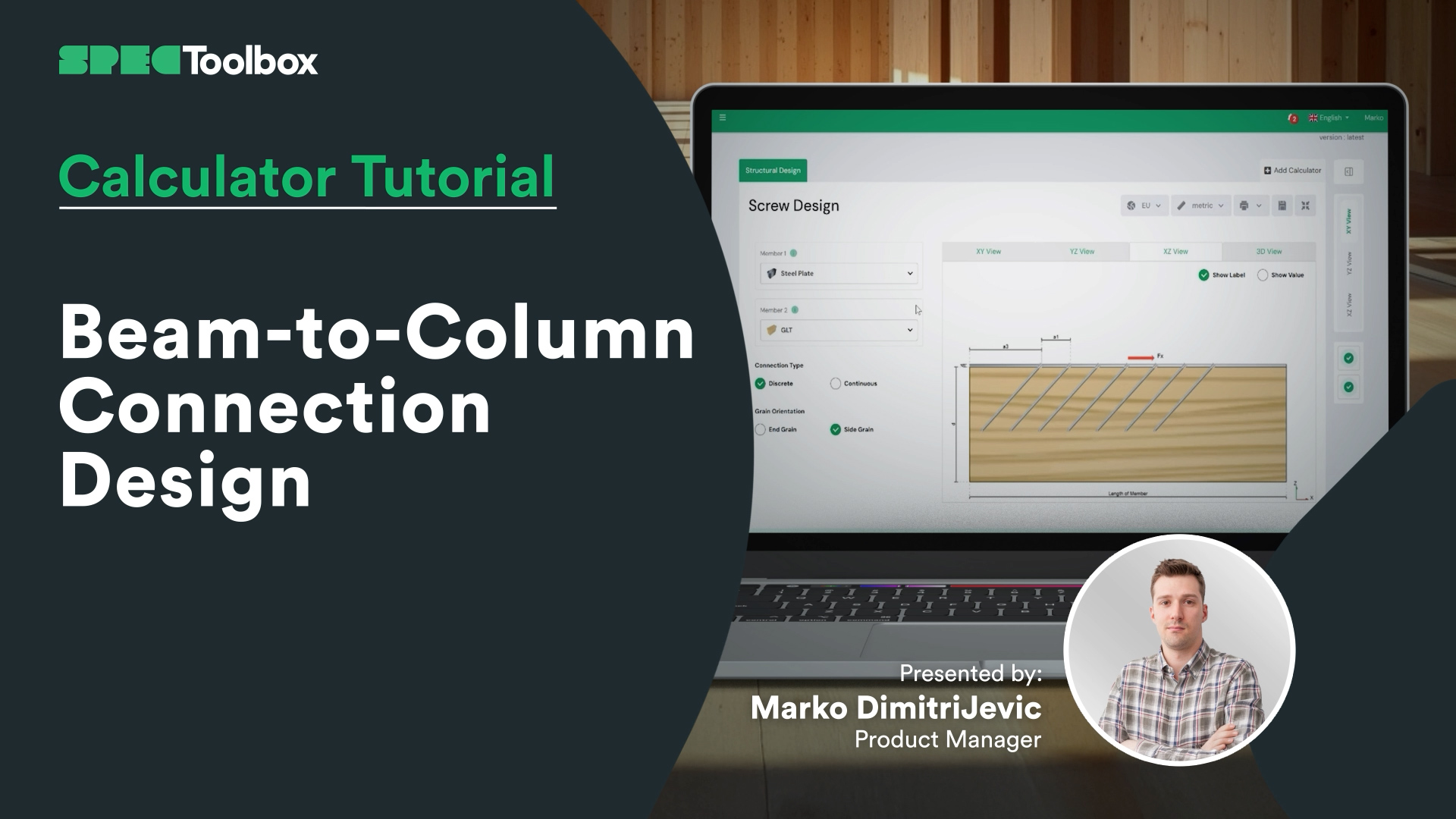
Beam-to-Column Connection Design
Gratuito, basato su browser, nessun download. Progetta qualsiasi connessione certificata nei tuoi materiali reali in pochi secondi.
Inizia a Progettare Gratuitamente →Metti i tuoi prodotti di fronte a ogni ingegnere che specifica sulla piattaforma, al momento della progettazione.
Fai specificare i tuoi prodotti →