Design Stud Walls to Eurocode 5
Design light-frame timber stud walls in Europe to Eurocode 5, verifying standard sections such as C16 and C24 against combined axial and wind loading using real timber grade properties rather than simplified assumptions. Buckling, bearing and deflection checks run automatically, with National Annex support for country-specific values across your project region. Try the calculator to specify a wall configuration you can take straight to certification.
Start Designing for Free See Integrated Suppliers- Standard: EN 1995-1-1:2004 (Eurocode 5)
- National annexes: National Annex activation supported with country-specific NDP codes; Austria (ÖNORM B)

Light-Frame · Eurocode 5
The Core of Timber Frame Construction
Timber frame is the dominant method for low-rise residential construction across the UK and Europe. Whether you are designing a load-bearing external wall or an internal partition, the vertical studs are the “spine” of the structure.
The SPEC Toolbox Stud Wall Calculator automates the complex stability checks of Eurocode 5. It allows you to verify standard solid timber sections (e.g., 140×38, 89×38 CLS) against buckling and wind deflection, replacing tedious manual interaction calculations.
The engineer's guide
Light-Frame · Eurocode 5
What This Calculator Does
This tool performs a rigorous analysis of a vertical timber stud as a “Beam-Column” element. It verifies:
- Axial Capacity (Nc,Rd): Checks compression strength, automatically calculating the buckling reduction factor (kc) based on wall height and restraint.
- Bending Capacity (My,Rd): Checks resistance to lateral wind loads acting on the face of the wall.
- Combined Actions (Interaction): The most critical check. Verifies the interaction between axial compression (from roof/floors) and bending (from wind) using Eurocode equations 6.23 and 6.24.
- Bearing (fc,90): Checks compression perpendicular to grain on the bottom plate/rail.
- Deflection: Calculates horizontal deflection of the stud under wind load to prevent damage to finishes (e.g., plasterboard cracking).
Overview of Light-Frame Timber Stud Design
SPEC Toolbox provides a dedicated Stud Design calculator that evaluates axial compression, bending effects, buckling behavior, and stability conditions for solid timber studs used in light-frame wall assemblies, in accordance with EN 1995-1-1:2004 (Eurocode 5), which defines compression member design, stability checks, and load combinations.
Timber Stud Properties
Define: Timber grade (e.g., C16, C24), Stud width (b), Stud depth (d), Stud spacing — determines cross-sectional resistance and slenderness, and load tributary area from floors/roofs.
Wall Type: Discrete wall (each stud independent) or Continuous wall (load redistribution between members).
Sheathing and Bracing Conditions: whether sheathing (OSB or plywood) is present, whether it provides lateral support, whether braced battens are installed — influences effective buckling length and overall wall stability.
European Timber Design Standard
Eurocode 5 (EN 1995-1-1:2004). National Annex support: engineers can activate the National Annex and select a country-specific NDP (Nationally Determined Parameters) code — example given: Austria – ÖNORM B. These adjust partial safety factors and other design values per national regulations.
Load Cases and Combinations
Load types: Permanent load (gk), Imposed load (qk), Wind load (wk), Snow load (s) — combined per EN 1990 and EN 1991. Load Combination Selection parameters: load combinations, loading code (EN 1991:2002), consequence class, design equation. Environmental/Service Conditions: service class (SC1, SC2, etc.), snow load category, imposed load category.
Axial Loads
Distributed loads transferred to each stud: Permanent (gk), Imposed (qk), Wind (wk), Snow (s) — tributary load carried by the stud.
Lateral Loads: Wind load (Wn-y) acting perpendicular to the wall surface, producing bending stresses combined with axial compression during verification.
Eurocode Stability Parameters
System Factor (ksys): accounts for load sharing between multiple members in a repetitive structural system.
Critical Buckling Calculation: engineers can determine whether the critical buckling coefficient (kcrit) should be evaluated.
Loaded Edge Condition: Compression edge, Center, or Tension edge — affects lateral torsional stability evaluation.
Automated Stud Capacity Checks
Bending Design, Compression Check, Strength Check (combined stresses within allowable limits), Buckling Verification (global buckling resistance), Lateral Torsional Stability. Output Summary dashboard with pass/fail indicators for: bending design utilization, compression utilization, strength interaction check, buckling verification, lateral torsional stability.
Light-Frame · Eurocode 5
Can I design "Double Studs"?
Does it check Fire Resistance?
What about racking/bracing?
What’s News
Dive into our newest releases, articles, and tutorials designed to help you succeed.

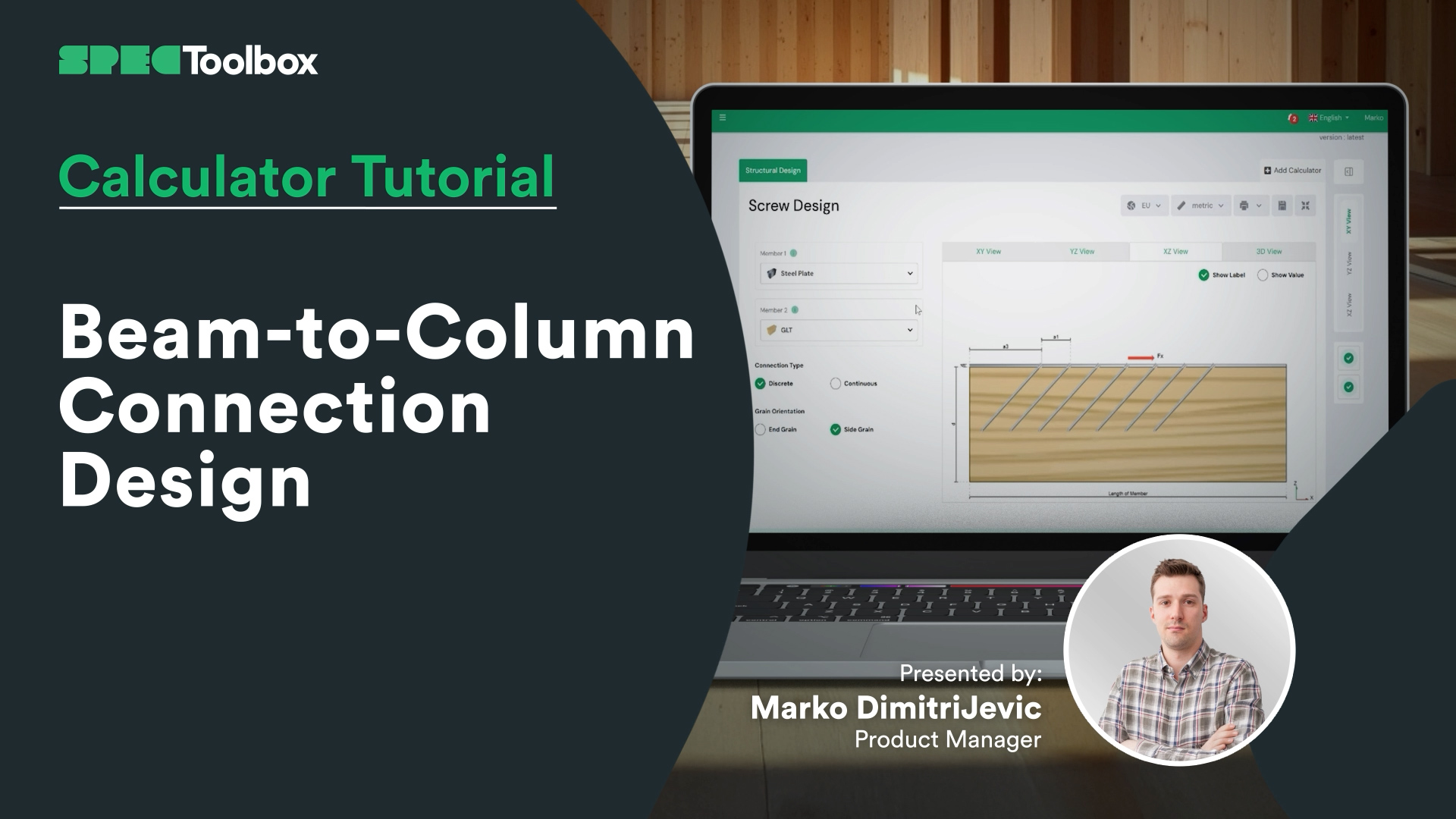
Beam-to-Column Connection Design
Gratuito, basato su browser, nessun download. Progetta qualsiasi connessione certificata nei tuoi materiali reali in pochi secondi.
Inizia a Progettare Gratuitamente →Metti i tuoi prodotti di fronte a ogni ingegnere che specifica sulla piattaforma, al momento della progettazione.
Fai specificare i tuoi prodotti →