Design Glulam Beams and Columns to AS 1720.1
Design glulam beams, columns, fire performance and connections in Australia and New Zealand to AS 1720.1, drawing on real product data from local and imported glulam suppliers so your section sizes and grades match what's actually available to specify. Bending, shear, bearing and stability are all checked automatically, with fastener data from leading connector manufacturers built into the connection modules. Try the calculators to specify your next glulam element with confidence.
Start Designing for Free See Integrated Suppliers- AS 1720.1:2010, NZS AS 1720 (EN 1995-1-1 also supported)

Partners
Integrated Suppliers
Every product below has live certified data wired into the calculators above — pick it from inside the tool.





About Glulam Design
Designing Glulam In Australia
Glue Laminated Timber (Glulam) is the workhorse of the Australian mass timber industry. Glulam offers superior dimensional stability and span capabilities compared to sawn timber. The SPEC Toolbox Glulam Calculator unifies the complex landscape of Australian & European supply. Whether you are specifying local ASH, or imported Binderholz product – the tool with Eurocode 5 & AS1720 included, has got you covered!
The engineer's guide
Glulam Design, AS 1720.1
The Australian Engineering Platform for Glulam Design
This tool performs a comprehensive structural analysis of Glulam beams and columns under gravity and wind loads. It verifies:
- Bending Capacity (Md): Checks major and minor axis moment capacity, applying all relevant modification factors (k1, k4, k6, k9, k12).
- Shear Capacity (Vd): Verifies vertical shear strength.
- Bearing (Nd): Checks Compression Perpendicular to Grain (f’p) at supports—often the governing check for narrow, high-load beams.
- Beam Stability (k12): The critical « Slenderness » check in AS 1720.1. The tool calculates the Material Constant (ρb) and Slenderness Coefficient (S1) to prevent lateral buckling.
- Deflection (Δ): Calculates short-term and long-term creep deflection (j2) to ensure the beam doesn’t sag over time.
Design of Glulam Beams
Supplier & Code Integration — the calculator supports multiple design codes including Eurocode 5 (EN 1995-1-1), AS 1720.1, and NZS AS 1720.
Analytical Methods for Glulam Behavior:
- Elastic Beam Theory: primary analytical approach, using classical Euler–Bernoulli beam theory, assuming linear elastic material behavior and plane sections remaining plane.
- Effective Section Properties: uses standardized section properties and grade-dependent stiffness values (e.g., GL grades or Australian supplier grades such as MASSLAM).
- Stability and Buckling Verification: checks for lateral-torsional stability and effective length factors, accounting for support conditions and restraint assumptions.
High-Performance Structural Design — evaluates bending resistance, shear resistance, lateral-torsional stability, and deflection behavior. Support Conditions (effective length factors and restraint assumptions); Design Parameters (service class, material grade, code-specific parameters).
Design of Glulam Columns
Supports Eurocode 5 (EN 1995-1-1), AS 1720.1, and NZS AS 1720. Material grades (GL grades or supplier-specific products like MASSLAM) evaluated per selected code.
Analytical Model: Elastic Member Analysis (linear elastic members, axial compression, bending moments from eccentric loads); Section Properties (section modulus, moment of inertia, radius of gyration auto-calculated); Load Eccentricity Effects (eccentricities in both principal directions).
Structural Performance Checks: Bending Verification (major/minor axis), Compression Verification, Combined Actions Verification, Buckling Verification (effective length factors, slenderness ratios, reduction factors), Lateral Torsional Stability.
Design of Glulam Members
Supplier Integration & Material Data — grades such as GL24h, GL28h, and supplier-specific products evaluated per AS 1720.1.
Analytical Model: Design Action Effects (forces entered directly as design action effects rather than derived from loads/spans); Section Properties; Member Configuration (columns or diagonal braces, length, analysis location, loading duration).
Structural Performance Checks: Bending Verification (Mx, My), Combined Bending Check, Compression Verification, Combined Bending and Compression, Shear Verification (Fx, Fy), Combined Actions Check, Stability Verification.
Design of Glulam Fire
Advanced Glulam Fire Engineering — implements timber fire design methodologies aligned with AS 1720.1 and international standards; calculates char depth development and reduced effective cross-section.
Precision Charring and Residual Section Analysis — users define basic charring rate (β₀) and notional charring rate (βₙ) with required fire resistance time; calculates char depth and effective residual section; accounts for different exposed faces and protection conditions.
Automated Fire Verification — evaluates Fire Bending Resistance, Fire Shear Resistance, Torsional Stability Under Fire Conditions.
Design of Glulam Connections
Advancing Structural Connection Design — Advanced Yield Modeling (Johansen Yield Models for dowel-type fasteners); Manufacturer Data Integration (supplier-specific fastener/connector data).
Simplified Structural Joint Design — preconfigured connection types: Dowel and Bolt Connections, Beam-to-Column Connections, Beam-to-Beam Connections, Compression Perpendicular to Grain (GLT), Beam Notch Verification, Shear Reinforcement Design, CLT Floor-to-Beam Interfaces.
« Global-Local » Connection Library — Universal Fastener Selection: Würth, Eurotec, Klimas, Rothoblaas, Schmid Schrauben, Sihga, SPAX, Simpson Strong-Tie. Verified Compatibility with glulam from ASH, Hyne, NeXTimber, Binderholz.
Design of Glulam Penetrations
Evaluated using AS 1720.1 together with NZ Wood Design Guide (Chapter 12.6); also supports prEN 1995:2023.
Penetration Geometry — circular or rectangular openings, opening size and spacing, position within cross-section, reinforced or unreinforced. Geometric limitations auto-verified per AS 1720.1/NZ WDG and prEN 1995:2023.
Reinforcement and Capacity Verification — self-tapping screws as reinforcement; supported fastener manufacturers: Würth, Rothoblaas, Eurotec, Klimas, Schmid, Sihga, SPAX, Simpson Strong-Tie. Glulam suppliers: ASH, Hyne, NeXTimber, Binderholz.
Automated Structural Checks: geometric limits for penetrations, tension resistance of unreinforced openings, flexural resistance of modified section, shear resistance near penetrations, reinforcement geometry requirements, reinforcement design capacity.
Glulam Design, AS 1720.1
Does this check Hardwood Glulam?
How do I check fire ratings?
Can I design curved beams?
What’s News
Dive into our newest releases, articles, and tutorials designed to help you succeed.

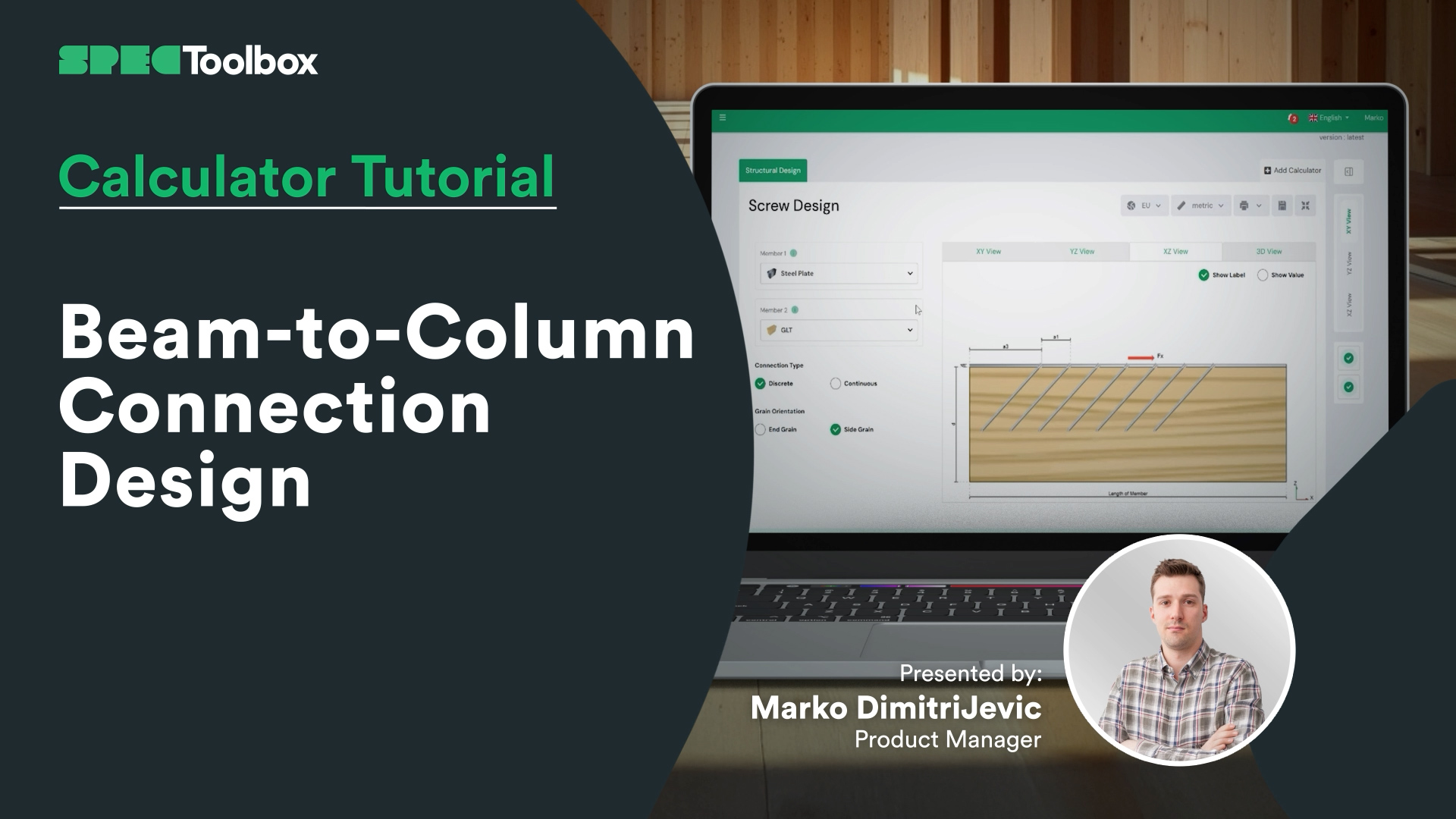
Beam-to-Column Connection Design
Gratuit, basé sur navigateur, sans téléchargement. Concevez n’importe quelle connexion certifiée dans vos matériaux réels en quelques secondes.
Commencez à concevoir gratuitement →Mettez vos produits à la disposition de chaque ingénieur spécifiant sur la plateforme — au moment de la conception.
Faites spécifier vos produits →