Design Glulam Beams and Columns to NDS
Design glulam beams and columns in the USA to NDS 2018, drawing on real glulam product data from suppliers including Binderholz, Mercer and SmartLam so your layup and grade choices match what's actually available to specify. Bending, shear, bearing and stability are checked automatically for standard American layups such as 24F-1.8E, with connection design covering dowels and bolts. Try the calculators to specify your next glulam element with confidence.
Start Designing for Free See Integrated Suppliers- Standard: AWC NDS 2018 (beams/columns), AWC NDS 2024 (connections), ASCE 7-16 loading

Partners
Integrated Suppliers
Every product below has live certified data wired into the calculators above — pick it from inside the tool.





About Glulam Design
American Glulam Engineering
Glue-Laminated Timber (Glulam) is the cornerstone of US mass timber, defined by the rigorous ANSI A190.1 manufacturing standard. From simple door headers to long-span roof trusses in Type IV construction, Glulam offers the strength of steel with the carbon benefits of wood.
The SPEC Toolbox Glulam Calculator is engineered for the American workflow. It automates the complex modification factors of the National Design Specification (NDS)—specifically the volume factor and beam stability—allowing you to specify standard layups (like 24F-1.8E) with complete confidence.
The engineer's guide
Glulam Design, AS 1720.1
What This Calculator Does
This tool performs a complete Allowable Stress Design (ASD) analysis of Glulam members under gravity and wind loads. It verifies:
- Bending Capacity (F’b): Checks positive and negative moment capacity, automatically applying the governing Volume Factor (CV) or Beam Stability Factor (CL).
- Horizontal Shear (F’v): Verifies shear capacity at the critical section (distance « d » from support).
- Bearing (F’c⊥): Checks compression perpendicular to grain at beam supports and concentrated load points.
- Volume Factor (CV): The unique NDS check for Glulam — strength influenced by total volume (Length × Width × Depth), unlike solid sawn lumber.
- Deflection: Calculates immediate and long-term deflection using the NDS creep component (Kcr).
Design of Glulam Beams
Supplier & Code Integration — integrates supplier-specific glulam data with AWC NDS 2018. Material grades evaluated using NDS design parameters; load combinations per ASCE 7-16; supports Allowable Stress Design (ASD) with adjustments for moisture conditions and temperature factors.
Analytical Model: Elastic Beam Theory (Euler–Bernoulli, plane sections remain plane); Section Properties (moment of inertia, section modulus, effective section area); Stability Considerations (restraint conditions and effective unbraced length per NDS stability provisions).
Structural Performance Checks: Bending Resistance (vs. allowable bending stress); Shear Resistance (vs. allowable shear strength); Stability Check Due to Bending (lateral instability, restraint system, effective length); Deflection Verification (vs. allowable span limits).
Design of Glulam Columns
Same NDS 2018 basis, ASCE 7-16 load combinations, ASD methodology with moisture (Cm) and temperature (Ct) factors. Grades such as GL24h, GL28h evaluated.
Analytical Model: Elastic Member Analysis (axial compression, bending from eccentric loads, interaction effects per NDS); Section Properties (section modulus, moment of inertia, radius of gyration); Load Eccentricity Effects (both principal directions).
Structural Performance Checks: Bending Verification (major/minor axes vs. allowable bending stress); Compression Verification (vs. allowable compressive stress parallel to grain); Combined Actions Verification (NDS interaction equations); Buckling Verification (effective length, slenderness ratios, NDS column stability factors); Stability Checks (member slenderness ratios and restraint conditions).
Design of Glulam Connections
Framework: AWC NDS 2024. Advanced Yield Modeling: NDS Yield Limit Equations for dowel-type fasteners, predicting governing failure modes under combined shear, tension and bending. Manufacturer Data Integration: supplier-specific glulam properties.
Supported Connection Type: Dowel and Bolt Connections, evaluated per AWC NDS dowel-type fastener provisions using NDS Yield Limit Equations.
« Global-Local » Connection Library: Universal Fastener Selection (bolts and dowels, NDS yield equations with load duration, moisture, temperature and time-effect factors). Verified Compatibility: Binderholz, Mercer, Nordic, and SmartLam.
Automated Structural Checks: Geometric Check, Yielding Resistance, Row Shear Resistance, Group Tear-Out Resistance, Net Tension Resistance — per AWC NDS 2024.
Glulam Design — NDS
What is the difference between "Balanced" and "Unbalanced"?
Does this check Camber?
Can I design curved beams?
What’s News
Dive into our newest releases, articles, and tutorials designed to help you succeed.

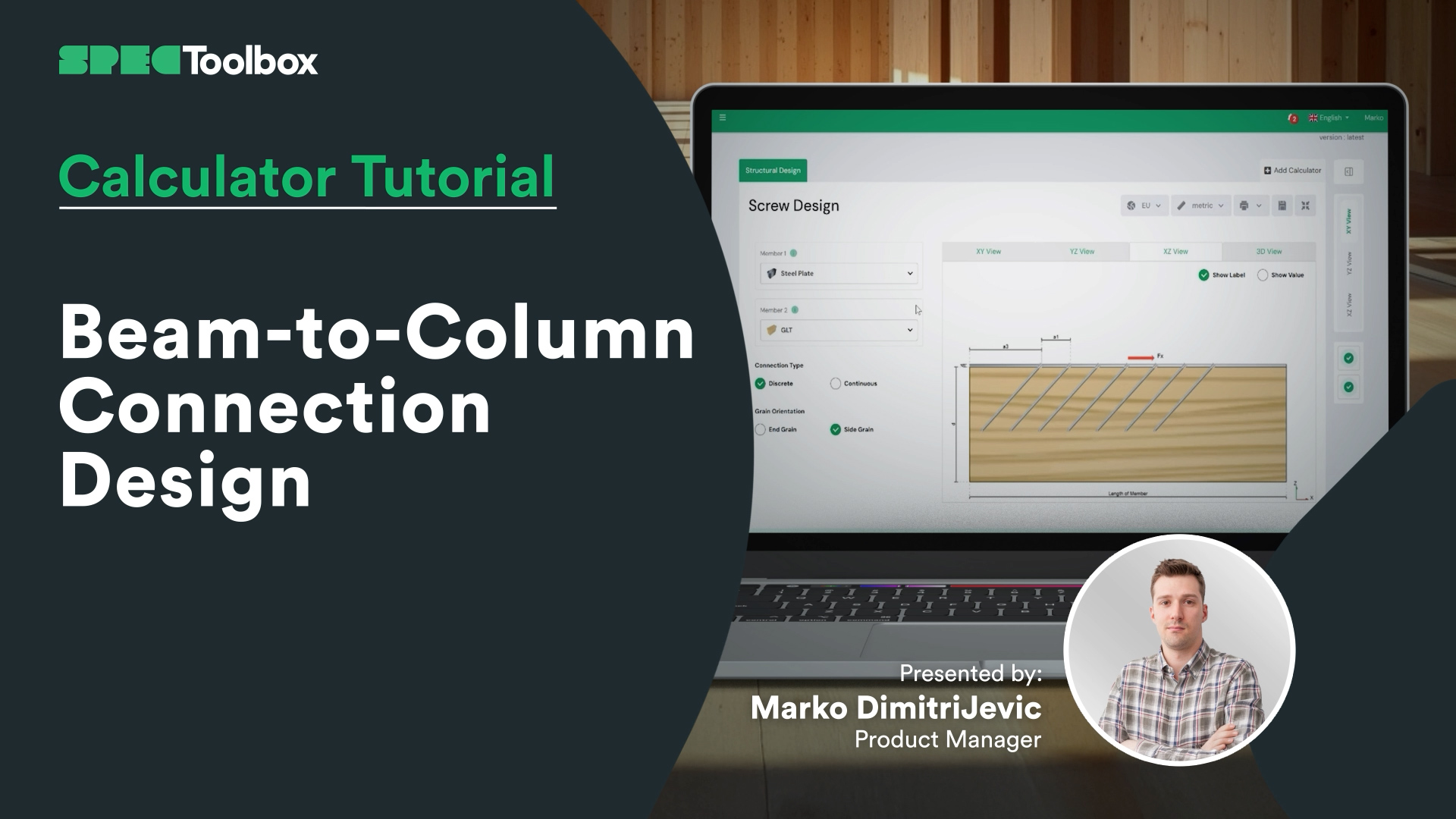
Beam-to-Column Connection Design
Gratuit, basé sur navigateur, sans téléchargement. Concevez n’importe quelle connexion certifiée dans vos matériaux réels en quelques secondes.
Commencez à concevoir gratuitement →Mettez vos produits à la disposition de chaque ingénieur spécifiant sur la plateforme — au moment de la conception.
Faites spécifier vos produits →