Design Wood Screw Connections to NDS
Design wood screw connections in the USA to NDS 2018 across sawn lumber, glulam and CLT, with real fastener geometry and strength data drawn from ICC-ES certified supplier products rather than a generic table. Lateral and withdrawal design values are calculated automatically, with a toggle between ASD and LRFD, or a switch to CSA O86 for Canadian projects. Try the calculator to specify your next screwed connection with confidence.
Start Designing for Free See Integrated Suppliers- Standard: AWC NDS 2018 (2024 referenced in connections context), incl. Supplier ICC-ES variant; CSA O86-19 also supported

Partners
Integrated Suppliers
Every product below has live certified data wired into the calculators above — pick it from inside the tool.





About Screw Design
The Consolidated Screw Engineering Platform
The NDS 2018 Screw Calculator is a sophisticated tool designed for structural engineers to perform comprehensive lateral and withdrawal design calculations for dowel-type fasteners. This powerful calculator helps you analyze and optimize connections in Sawn Lumber, Glulam, and Mass Timber (CLT) with precision and efficiency.
The engineer's guide
Wood Screw Connections
Key Features
- Automated Yield Limit Equations: Instantly solve all six NDS Yield Modes (Im, Is, II, IIIm, IIIs, IV) to find the controlling Lateral Design Value (Z).
- Withdrawal & Pull-Through: Calculate Withdrawal Design Values (W) and Head Pull-Through resistance (WH) based on specific gravity and thread penetration.
- Code Compliance: Adheres strictly to NDS 2018 (USA) and CSA O86-19 (Canada) standards, including LRFD and ASD formats.
- Mass Timber Ready: specialized support for Dowel-Type fasteners in Cross-Laminated Timber (CLT) per ANSI/APA PRG-320.
- Supplier Agnostic: Design with standard ASME Lag Screws or select from a database of proprietary Self-Tapping Screws (STS).
Overview of Structural Screw Connections
Self-tapping screws are widely used in timber construction in North America for transferring axial and shear forces between structural elements. The SPEC Toolbox Screw Design module evaluates screw connections using AWC NDS (National Design Specification for Wood Construction) provisions together with manufacturer-specific screw data. Supported materials: Softwood, Hardwood, Glulam (GLT), Cross-Laminated Timber (CLT), Laminated Veneer Lumber (LVL), Plywood, Steel plates for timber-to-steel connections.
Interactive Connection Model
3D visualization displaying member geometry, screw orientation, screw placement, applied forces. Users can rotate and inspect the connection model before performing structural checks.
Primary and Secondary Member Definition
Member 1 (primary), Member 2 (secondary/connected). Properties: member type, member dimensions, elastic modulus, tensile strength, shear strength — used per AWC NDS provisions. Also definable: grain orientation (side grain or end grain), connection type (discrete or continuous).
Applied Forces
Fx (shear x-direction), Fy (shear y-direction), Fz (axial along screw axis). Resulting shear force V auto-calculated. Loads visualized within the connection model.
Supplier and Product Library
Define: screw supplier, screw family, specific screw type. Properties: screw diameter, thread configuration, embedment characteristics, withdrawal resistance parameters.
Screw Type and Thread Configuration
Partially threaded, Fully threaded — determines whether fastener primarily resists axial tension, shear forces, or combined loading. Supports smart screw length selection.
Supported Design Methods
- AWC NDS 2018 — standard design procedure defined by the American Wood Council for wood connections, evaluating screw resistance using NDS dowel-type fastener provisions.
- AWC NDS 2018 (Supplier ICC) — connection design using manufacturer-verified fastener properties certified through ICC-ES evaluation reports.
Design Philosophy: LRFD (Load and Resistance Factor Design — applies load and resistance factors for ultimate limit states) or ASD (Allowable Stress Design — evaluates capacity using allowable stresses and service load combinations).
Screw Arrangement and Spacing
Manual Arrangement: number of screws, row configuration, edge distances, end distances.
Minimum Distance and Spacing Rules: auto-applies per AWC NDS — spacing along rows, spacing between rows, edge distances, end distances, fastener position relative to member surface.
Connection Capacity Checks
- Brittle Failure: row tear-out capacity, net tension capacity, group tear-out capacity.
- Geometry Check: spacing/edge/end distances per design standard.
- Shear Capacity: based on timber properties and fastener resistance models.
- Axial Capacity: based on withdrawal resistance and fastener properties.
- Combined Actions: verifies combined axial and shear loading condition.
Wood Screw Design
Does this calculator support ASD and LRFD?
Can I use this for Canadian projects (CSA O86)?
What’s News
Dive into our newest releases, articles, and tutorials designed to help you succeed.
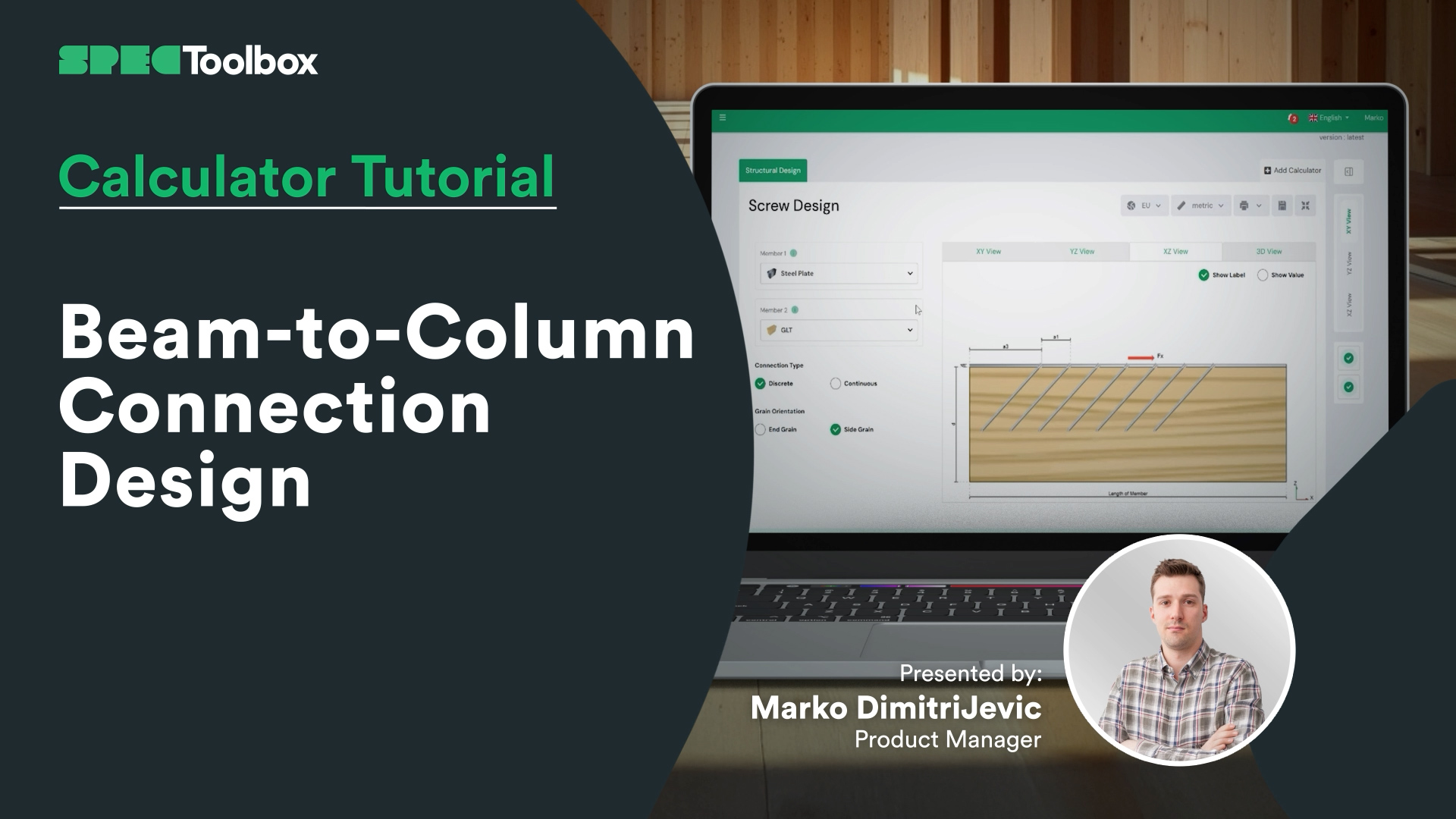
Beam-to-Column Connection Design

CLT Floor-to-Wall Connection Design
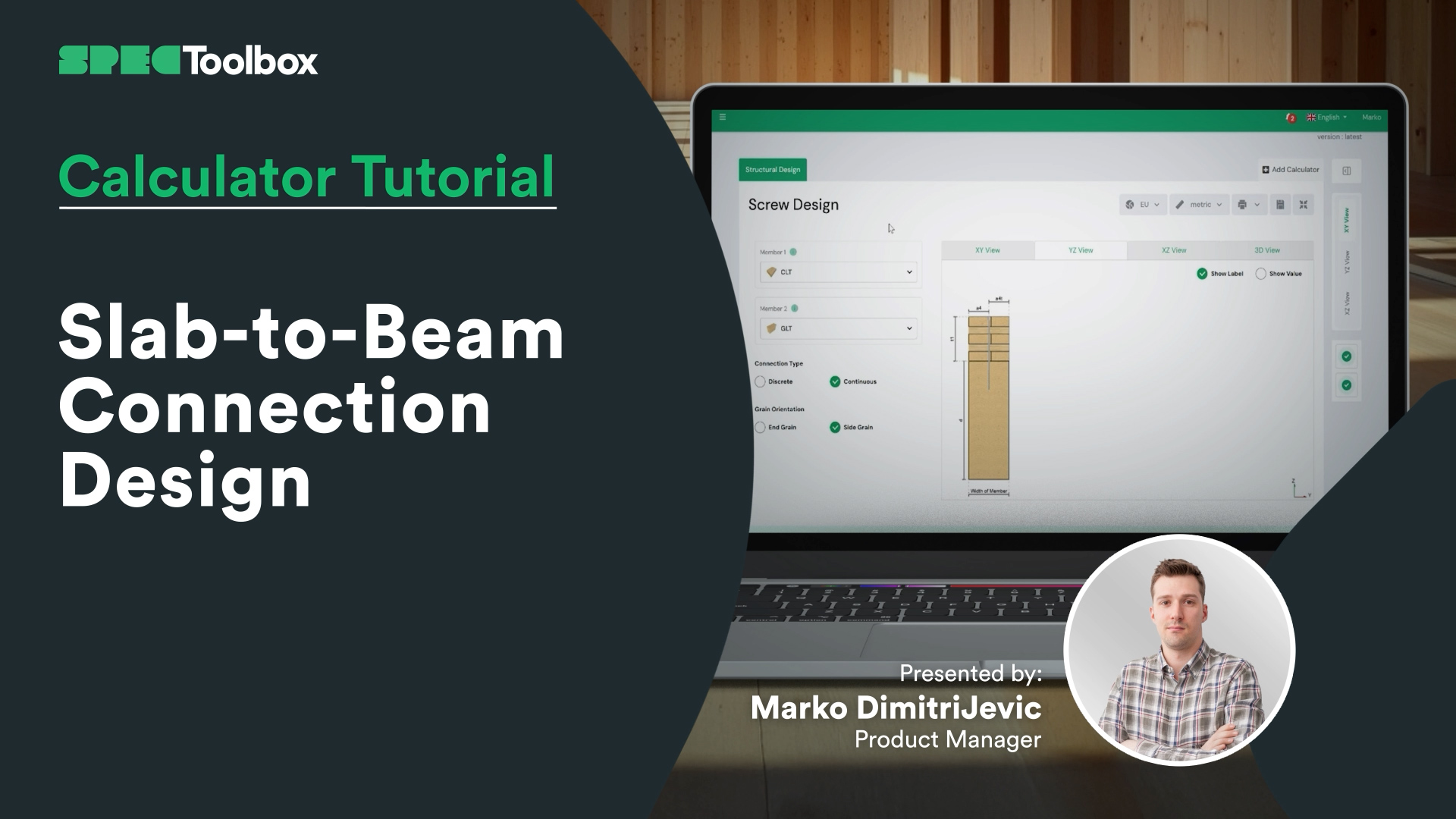
Slab-to-Beam Connection Design


Screws: Laterally loaded timber to timber end grain
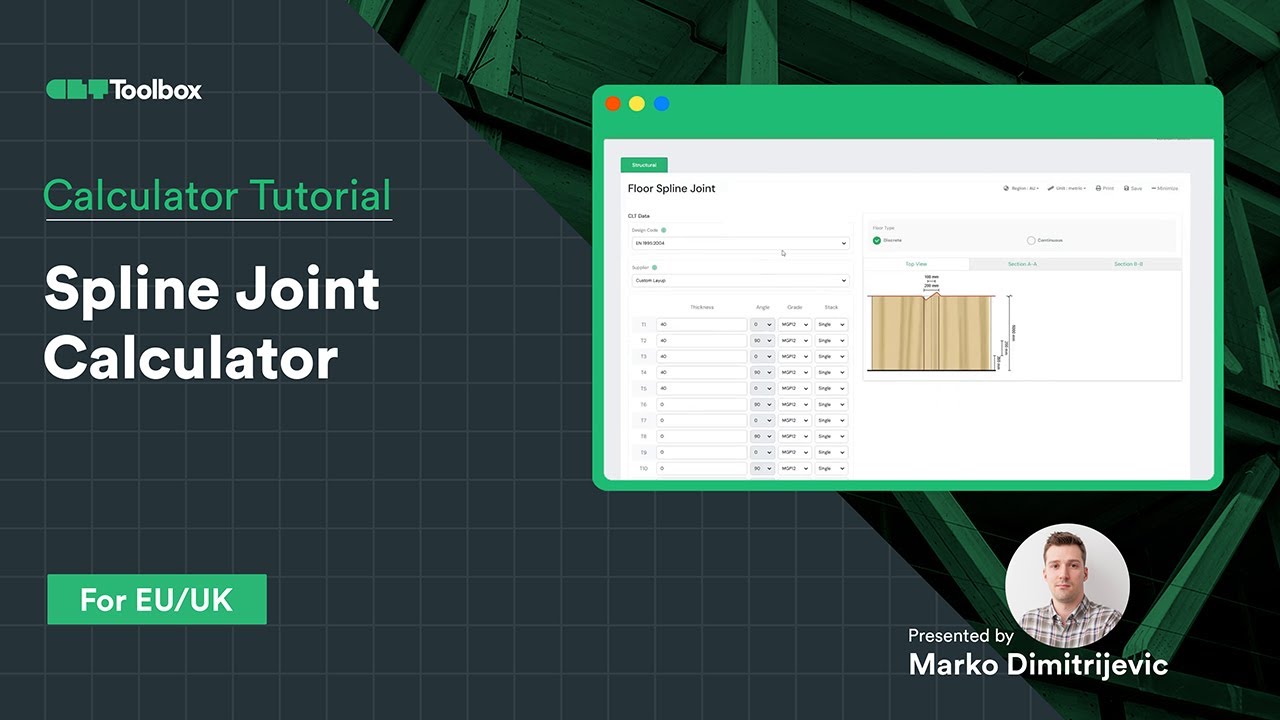
Spline Connection Calculator
Gratuit, basé sur navigateur, sans téléchargement. Concevez n’importe quelle connexion certifiée dans vos matériaux réels en quelques secondes.
Commencez à concevoir gratuitement →Mettez vos produits à la disposition de chaque ingénieur spécifiant sur la plateforme — au moment de la conception.
Faites spécifier vos produits →