
CLT Design Software for CSA O86
Design CLT according to CSA O86-19 and ANSI/APA PRG 320. The easiest way to verify Mass Timber elements for Canadian Limit States Design. Try our free webtool to see the power of SPEC in seconds!
Mass Timber Engineering Platform for Canada
Canada is a global leader in Mass Timber, from the tall wood buildings of Vancouver to the institutional projects of Toronto. However, ensuring compliance with CSA O86 (Engineering Design in Wood) requires navigating complex composite theory and strict vibration limits.
The SPEC Toolbox CLT Calculators are built for the Canadian workflow. It handles the rigorous Limit States Design (LSD) checks required by the National Building Code of Canada (NBCC). Whether you are specifying standard SPF panels or high-performance Douglas Fir, this tool unifies the supply chain into one metric, code-compliant platform.
The Mass Timber Engineering Platform
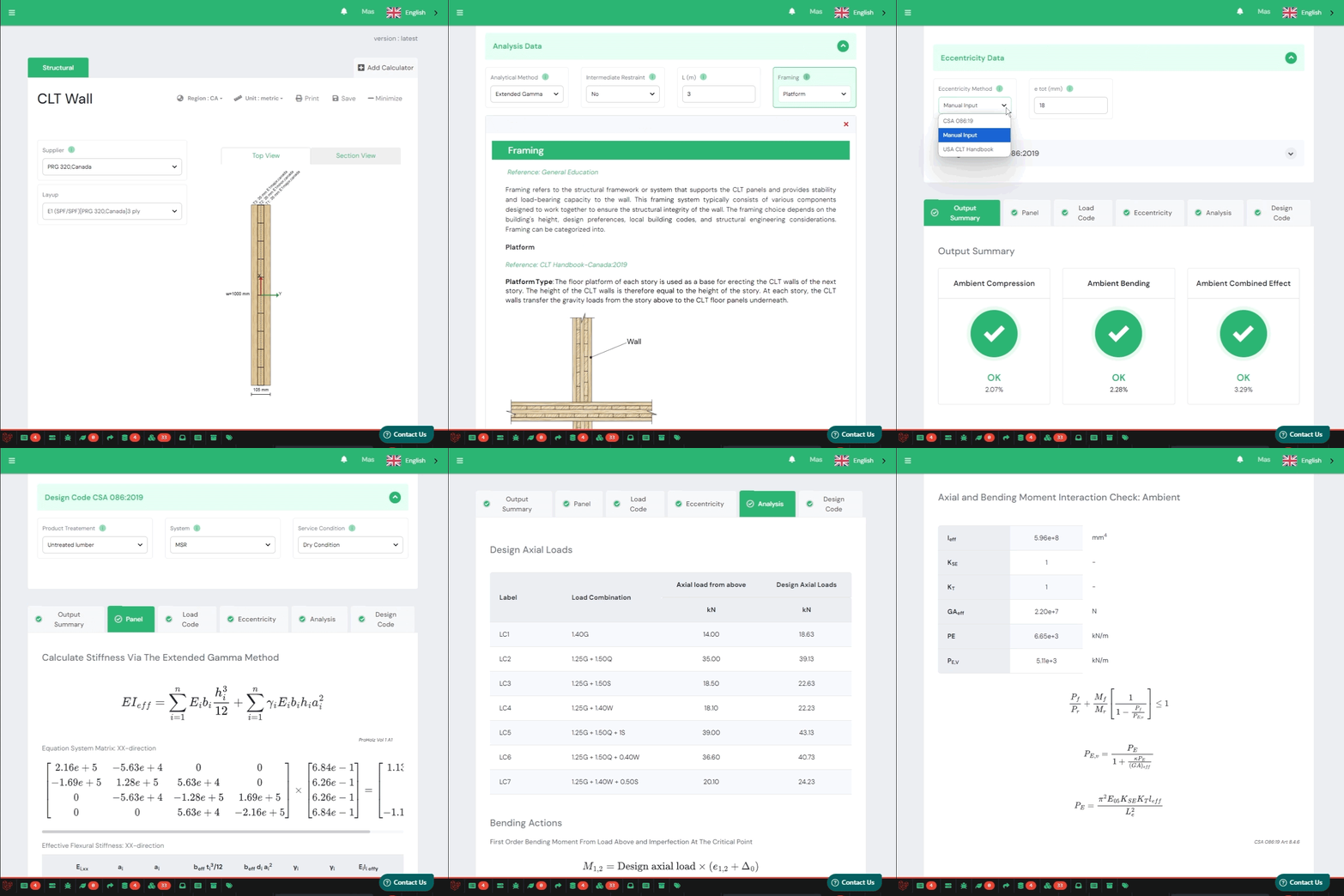
This tool performs a complete rational analysis of CLT panels under gravity loads, utilizing the Shear Analogy or Gamma Method as permitted by CSA O86. It checks:

Mises à jour de nos partenaires
La plateforme connaissant la croissance la plus rapide pour les spécifications relatives au bois
Key CLT Design Capabilities
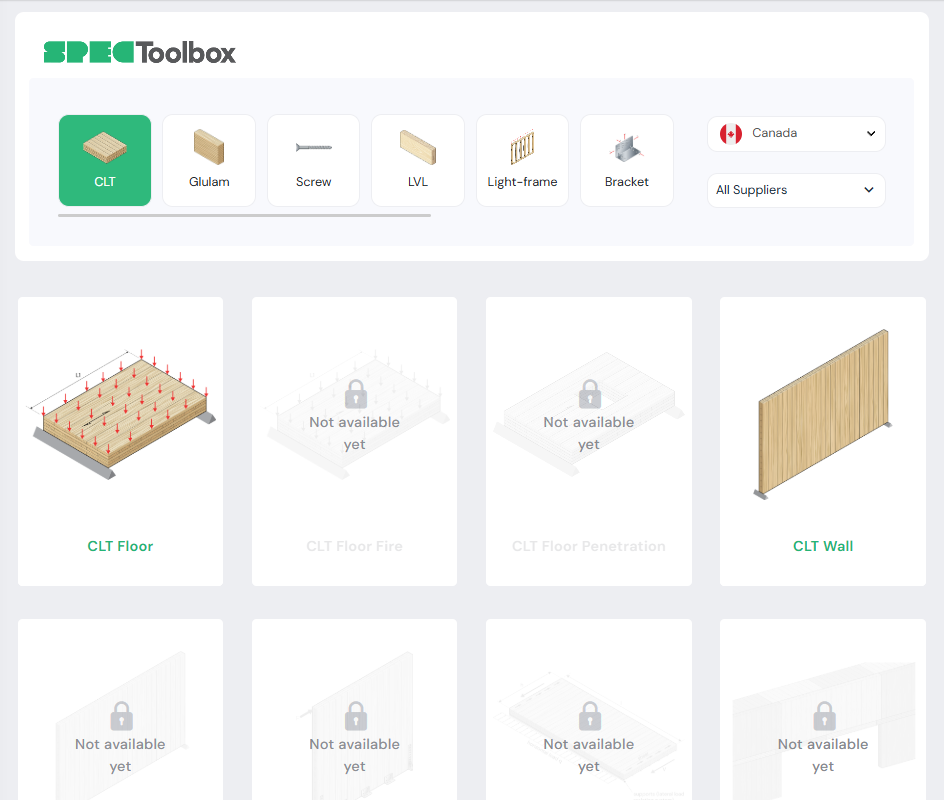
Design of CLT Floors
Supplier & Code Integration
Effective CLT floor design in Canada starts with the correct application of Canadian timber material and load standards. Our platform integrates supplier data with CSA O86 requirements and National Building Code of Canada (NBC) loading provisions, enabling fast and reliable structural verification.
The tool connects manufacturer CLT panel properties with recognized Canadian design standards, allowing engineers to evaluate floor systems using consistent material data and code-compliant structural verification.
Analytical Methods for CLT Stiffness
-
The Gamma Method: Best for standard, uniform CLT panels with 3, 5, or 7 layers. It accounts for the rolling shear deformation in the cross-layers by using a simplified efficiency factor.
-
The Extended Gamma Method: Our recommended method for thick panels (7-ply and above) or non-uniform layups. It provides a more refined calculation of effective stiffness by accounting for the rolling shear stiffness of every individual cross-layer, preventing overly conservative designs.
-
The Shear Analogy Method: The most rigorous analytical approach, suitable for highly complex or asymmetric layups. It treats the panel as a composite beam with distinct bending and shear stiffness components, providing the highest level of accuracy for all layup configurations.
High-Performance Vibration Design
Vibration is often the governing serviceability limit state for CLT floors. We have included the latest Eurocode drafts to provide a superior design outcome:
-
Support Conditions: Model realistic scenarios including stiff or flexible supports to accurately predict floor behavior.
-
Performance Levels: Specify target performance levels to meet specific building requirements, moving beyond simple frequency checks to holistic occupant comfort.
This calculator goes beyond simple static deflection. The tool analyzes the Fundamental Frequency (f1) and Impulsive Velocity Response, allowing you to tune the floor mass and stiffness to meet strict vibration criteria (e.g., 8Hz for offices), ensuring the “feel” of the floor matches the quality of the building.

Design of CLT Fire
CLT Fire Design Calculators in under development and will be available in the soon.
Design of CLT Connections
CLT Connections Design Calculators in under development and will be available in the soon.
Design of CLT Shear Walls
CLT Shear Wall Design Calculators in under development and will be available in the soon.
The Ultimate CLT Design Platform for Canadian Structural Engineers
If you’re looking to design CLT on your next project, then SPEC Toolbox has you covered!
Tutorials
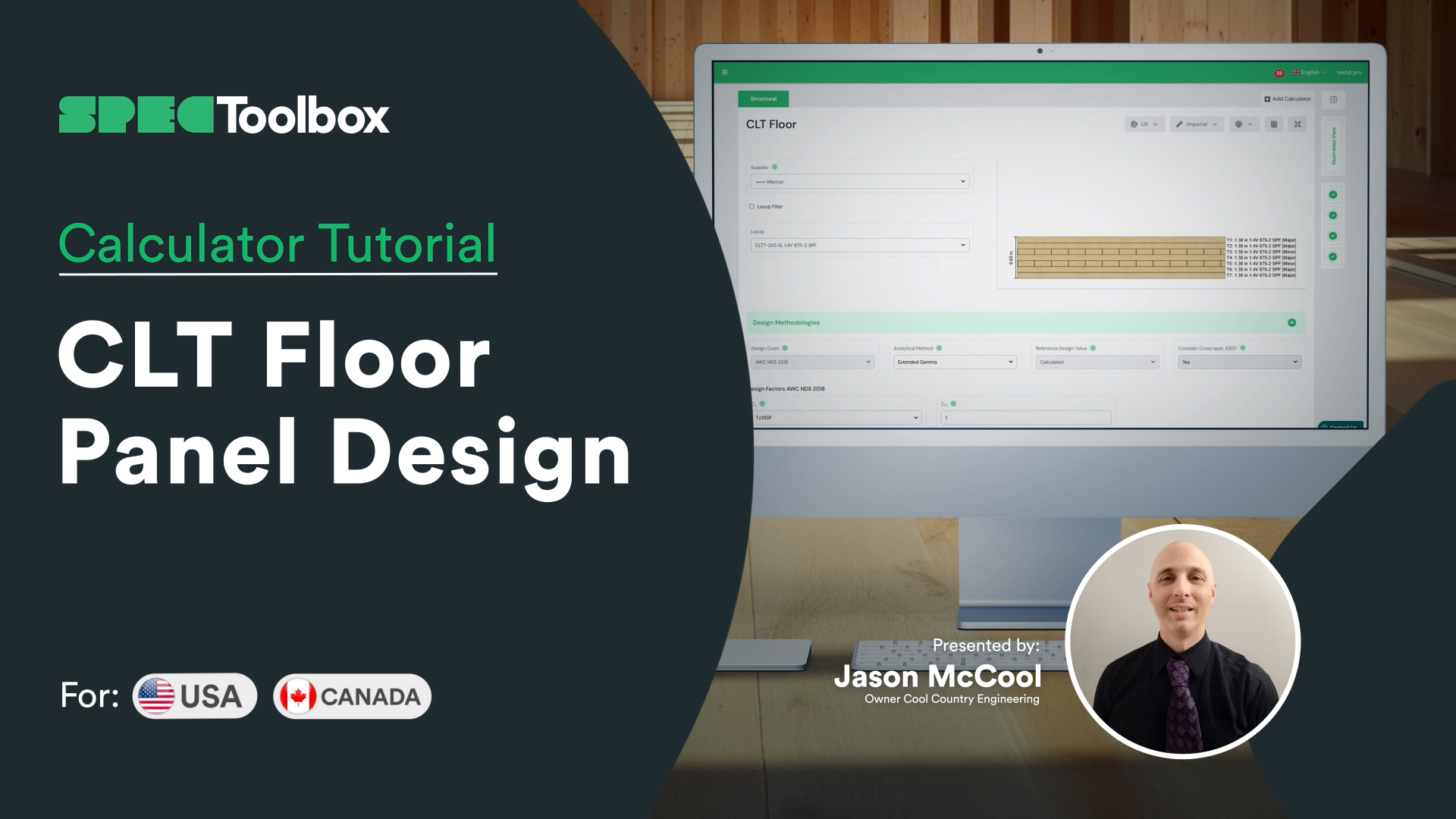
CLT Floor Panel Design
Design a 45 ft triple-span CLT floor in minutes with SPEC Toolbox: In this step-by-step demo, we show how to use SPEC Toolbox CLT Floor Calculator to design a mass timber office floor according to the US standards (AWC NDS), from setting spans and supports to adding loads, selecting suppliers/layups, applying deflection limits, and running vibration checks.
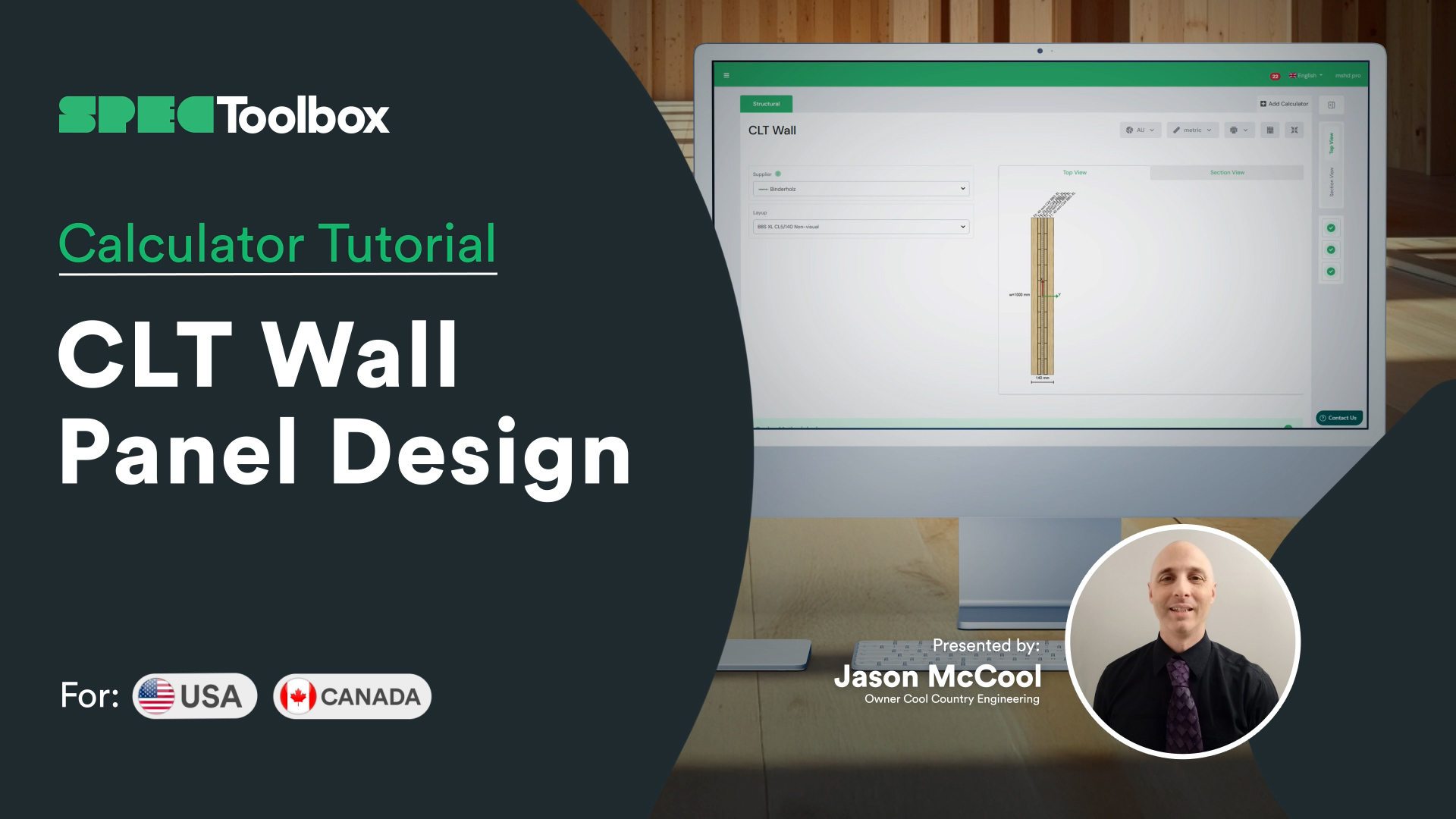
CLT Wall Panel Design
Check a 40′ balloon-framed CLT wall for gravity loads with SPEC Toolbox. In this demo, we use the CLT Wall calculator to verify a tall core wall under gravity loading. You’ll see how to set up panel geometry and intermediate restraint, enter loads per the design example, account for eccentricity using the USA CLT Handbook method (or manual inputs), and quickly review an extensive results summary to identify governing checks.
Frequently Asked Questions
Does this support SPF (Spruce-Pine-Fir)?
Yes. SPF is the backbone of the Canadian timber industry. You can select standard “V2” grades which utilize SPF No.1/No.2 lumber, or select custom SPF layups.
How is Vibration calculated?
We use the vibration design method outlined in the CSA O86 appendices and the CWC Wood Design Manual. This checks the fundamental frequency ($f_n$) and stiffness ($1$ kN deflection) to ensure the floor doesn’t feel “bouncy.”
Is this compliant with the NBCC?
Yes. The calculator generates a design report referencing the specific clauses of CSA O86-14/19, suitable for submission as part of your structural package.






 CLT
CLT Dowels
 GLT
GLT Vis
Vis