
Glulam (GLT) Design for AS1720
Launch the free Glulam Beam Calculator below & verify your design in seconds!
Designing Glulam In Australia
Glue Laminated Timber (Glulam) is the workhorse of the Australian mass timber industry. Glulam offers superior dimensional stability and span capabilities compared to sawn timber.
The SPEC Toolbox Glulam Calculator unifies the complex landscape of Australian & European supply. Whether you are specifying local ASH, or imported Binderholz product – the tool with Eurocode 5 & AS1720 included, has got you covered!
The Australian Engineering Platform for Glulam Design
This tool performs a comprehensive structural analysis of Glulam beams and columns under gravity and wind loads. It verifies:

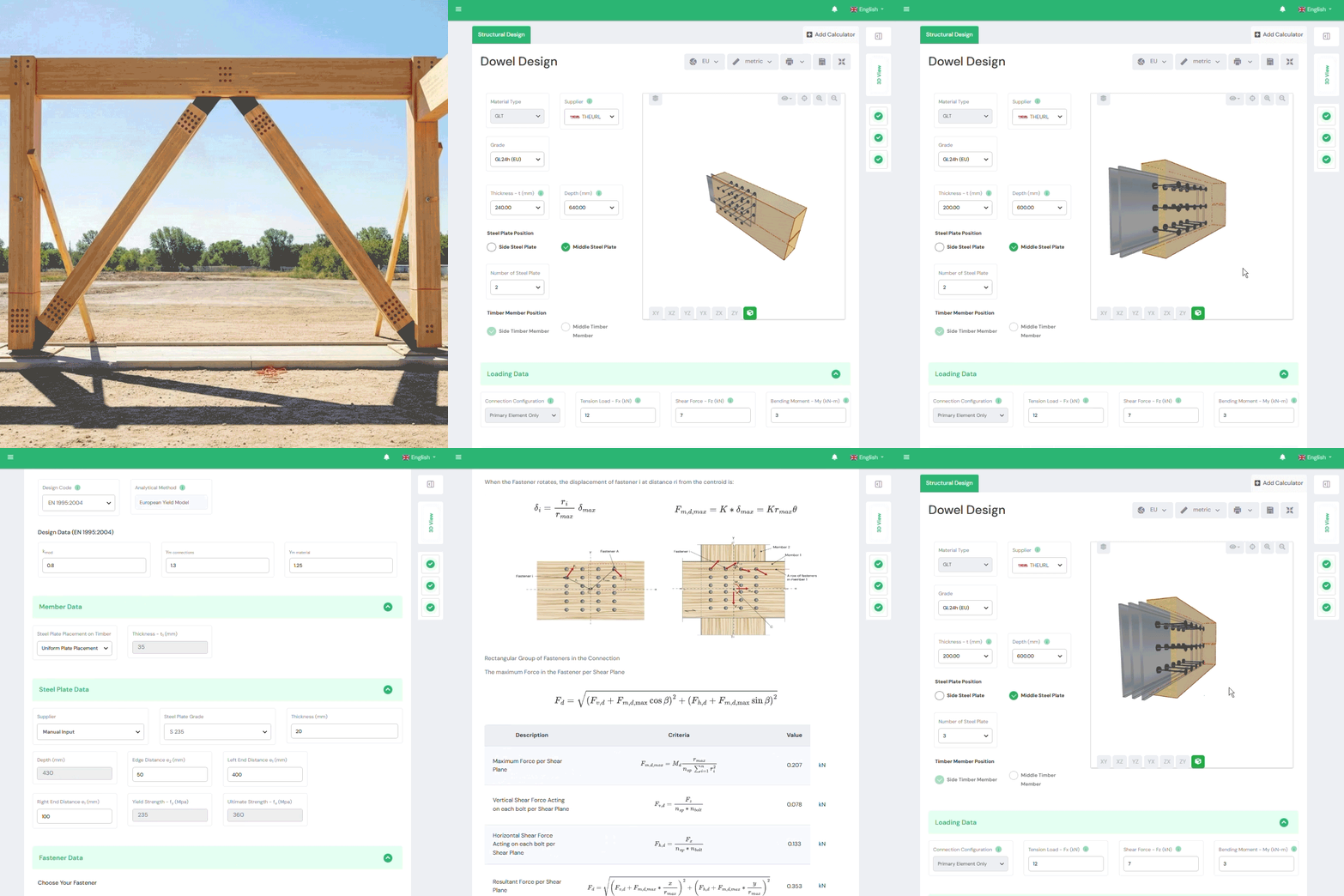
About : Glulam Design
Technical Guide: Designing to AS 1720.1
1. The “Grade Confusion” (GL17 vs. GL24)
Australian engineers often face a choice between local and imported products, which use different grading logic.
- GL17 (Local): Stiffness-driven. Typically Radiata Pine. High MOE (16,700 MPa) but lower bending strength (f’b approx 30-33 MPa).
- GL24/GL28 (Imported): Strength-driven. Typically European Spruce. Lower MOE (11,000-12,500 MPa) but high bending strength.
Our calculator automatically adjusts the E-values and characteristic strengths based on your selection, ensuring you don’t inadvertently use a “stiff” GL17 modulus for a “flexible” GL24 beam.
2. Beam Stability Factor (k12)
Unlike steel beams which check “LTB,” AS 1720.1 uses the k12 Factor to reduce capacity based on slenderness.
The calculator analyzes your Restraint Conditions (e.g., “Top edge restrained by flooring”) to calculate the effective length (Lay).
- Low Risk: Beams with continuous lateral restraint (k12 = 1.0).
- High Risk: Deep, narrow beams (Fly-braced or free-standing) where k12 can drop significantly below 1.0.
3. Column Stability (k12 for Columns)
For columns, the stability factor (k12) accounts for buckling about the x-axis or y-axis.
The tool calculates the Slenderness Coefficient (S3 or S4) based on the effective buckling length (g13 • L) and applies the interaction equation for combined axial and bending loads.
Key Formulas & Parameters
Capacity Factors (Φ):
We apply the standard AS 1720.1 capacity factors:
- Φ = 0.95 (Typical for Glulam, which is a controlled engineered product).
- Note: This is higher than Sawn Timber (Φ=0.90), reflecting the reliability of lamination.
Modification Factors:
- k1 (Duration of Load): Critical for timber. A beam that works for “Wind” (k1=1.14) might fail under “Dead Load” (k1=0.57). The tool checks all load cases.
- k4 (Partial Seasoning): Typically 1.0 for Glulam (manufactured dry).
- j2 (Creep): For long-term deflection limits (e.g., Span/300), the tool applies the creep factor (j2=2.0 for unseasoned, 1.5-2.0 for Glulam depending on exposure).
Bearing Area:
Nd = Φ • k1 • k4 • k6 • k7 • f’p Ap
- k7: The bearing length factor. The tool automatically increases bearing capacity if the bearing length is short (<150mm) and away from the beam end.
Tutorials
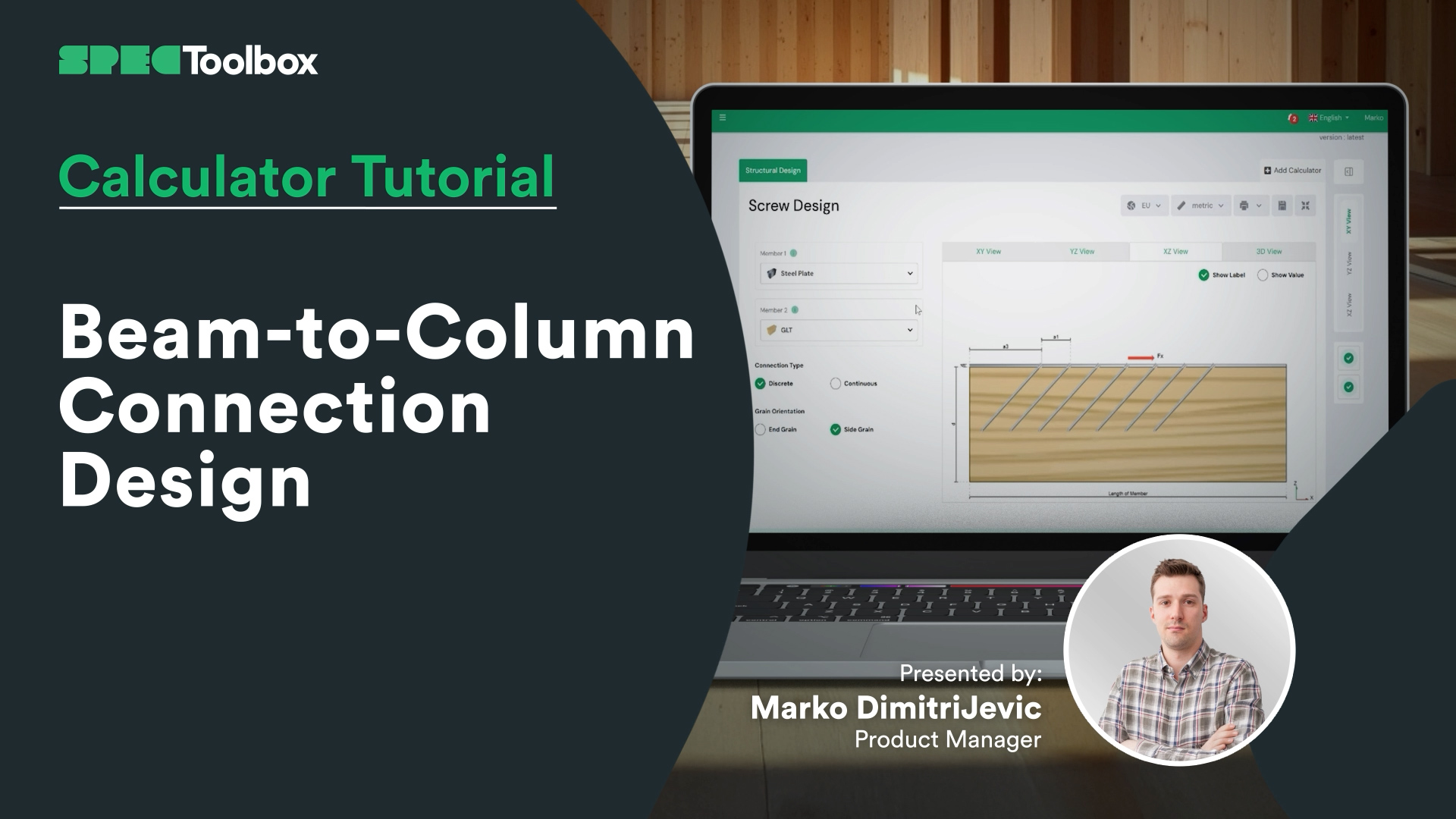
Beam-to-Column Connection Design
Beam-to-Column Connection Tackle the complexity of Beam-to-Column joints in this focused tutorial. We demonstrate how to replace complex bespoke steelwork with smart screw arrangements. Using the Screw Module, we verify the capacity of inclined screw groups to handle significant shear loads directly at the support interface.
Key Screw Benefits:
Crossed-Screw Configurations: Shows how arranging screws in crossed pairs (X-formation) significantly boosts stiffness.
Ductility & Safety: detailed look at how modern structural screws provide necessary ductility for safe, predictable failure modes.
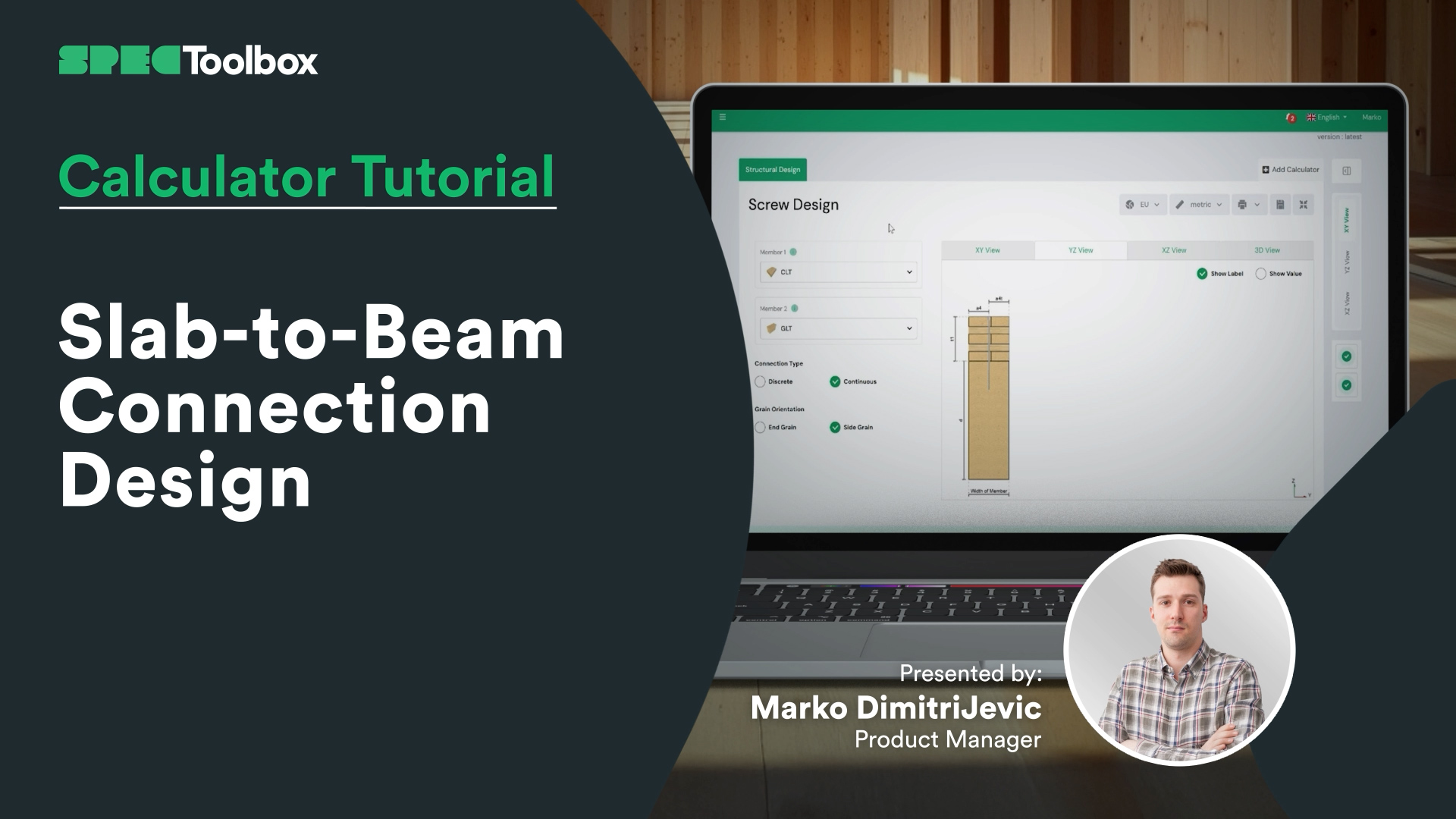
Slab-to-Beam Connection Design
Calcolatore per colonne in legno
In questo video vi guideremo nella progettazione di una colonna in legno utilizzando i carichi dell'area tributaria, in conformità con le norme Eurocodice 5 e AS1720. Iniziamo selezionando il materiale giusto che non solo soddisfi i requisiti strutturali, ma sia anche adatto alle esigenze di progettazione. Quindi, descriviamo in dettaglio come inserire i carichi provenienti dalle colonne soprastanti e dalla trave sostenuta, assicurandoci che ogni forza sia presa in considerazione. Una parte essenziale di questo processo è l'integrazione dei carichi laterali dovuti al vento. Mostriamo anche come ottimizzare la sezione trasversale per migliorare sia l'efficienza che le prestazioni.
Noi di CLT Toolbox siamo appassionati di #masstimber: è sostenibile, innovativo e sta cambiando il modo in cui costruiamo. Ci piace il modo in cui racchiude resistenza, durata e vantaggi ambientali in un unico pacchetto intelligente. Nel nostro video, analizziamo il processo con consigli semplici e spiegazioni chiare, in modo che possiate mettere in pratica questi metodi nei vostri progetti. Se siete pronti a portare il vostro lavoro di progettazione nel futuro, restate con noi e immergiamoci insieme in questo mondo.

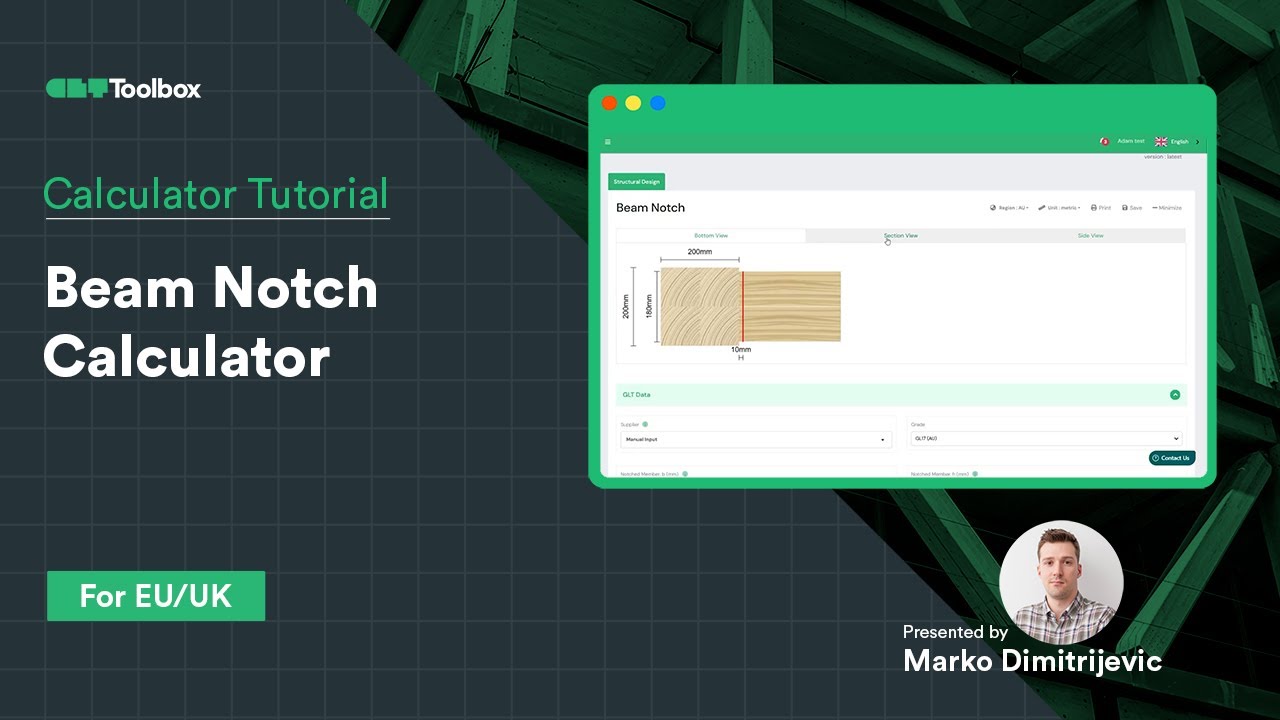
Calcolatore dell'intaglio della trave
Progettazione e verifica di un'intaglio in trave GLT secondo EC5 con CLT Toolbox
La domanda chiave: la sezione trasversale ridotta fornisce una capacità sufficiente o è necessario un rinforzo con viti?
Ecco cosa abbiamo trattato in questo video:
– Come verificare la capacità dell'intaglio utilizzando EC5
– Quando e come utilizzare le viti di rinforzo in base ai dati ETA forniti dai fornitori
– Introduzione agli input relativi alla geometria delle viti
– Come la posizione, l'orientamento e la quantità delle viti possono ottimizzare la progettazione
Una guida pratica per realizzare giunti in legno sicuri ed efficienti. Mi piacerebbe conoscere le vostre opinioni o esperienze con progetti simili!
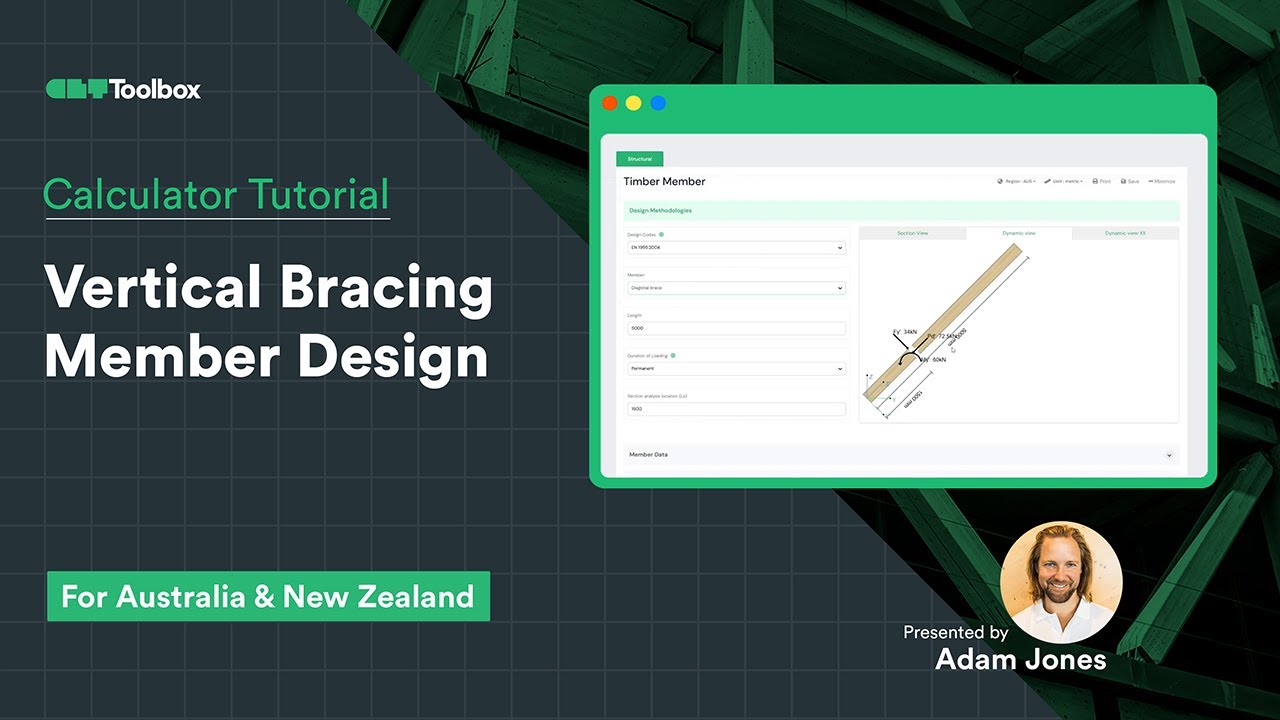
Progettazione di elementi di rinforzo verticali
Scopri come utilizzare il calcolatore CLT Toolbox Member Calculator per progettare un rinforzo diagonale verticale. Ti guideremo nell'importazione dei risultati delle analisi da strumenti esterni, nell'identificazione delle forze massime di tensione e compressione e nella selezione degli input corretti: classi, sezioni, specifiche del codice e forze. Inoltre, analizzeremo i risultati, coprendo le proprietà dei materiali e tutti i controlli di progettazione chiave. CLT Toolbox è qui per essere il tuo partner nella progettazione di progetti in legno!
Calcolatore per colonne in legno
In questo video vi guidiamo nella progettazione di una colonna in legno utilizzando i carichi dell'area tributaria, il tutto in linea con le linee guida dell'Eurocodice 5. Iniziamo selezionando il materiale giusto e l'allegato nazionale, assicurandoci che il vostro punto di partenza sia solido e conforme alle norme. Successivamente, vi mostriamo come inserire i carichi appropriati dalle colonne soprastanti e dalla trave sostenuta. Trattiamo anche il passaggio cruciale dell'aggiunta dei carichi laterali del vento. Man mano che procediamo, vedrete come ottimizzare la sezione trasversale della vostra colonna sia in termini di resistenza che di efficienza.
Noi di CLT Toolbox siamo appassionati del legno massiccio, perché è sostenibile, innovativo e sta cambiando il modo in cui costruiamo. Ci piace il fatto che riunisca resistenza, durata e vantaggi ambientali in un unico prodotto intelligente. Nel nostro video analizziamo il processo con consigli semplici e spiegazioni chiare, in modo che possiate mettere in pratica questi metodi nei vostri progetti. Se siete pronti a portare il vostro lavoro di progettazione nel futuro, restate con noi e immergiamoci insieme in questo mondo.

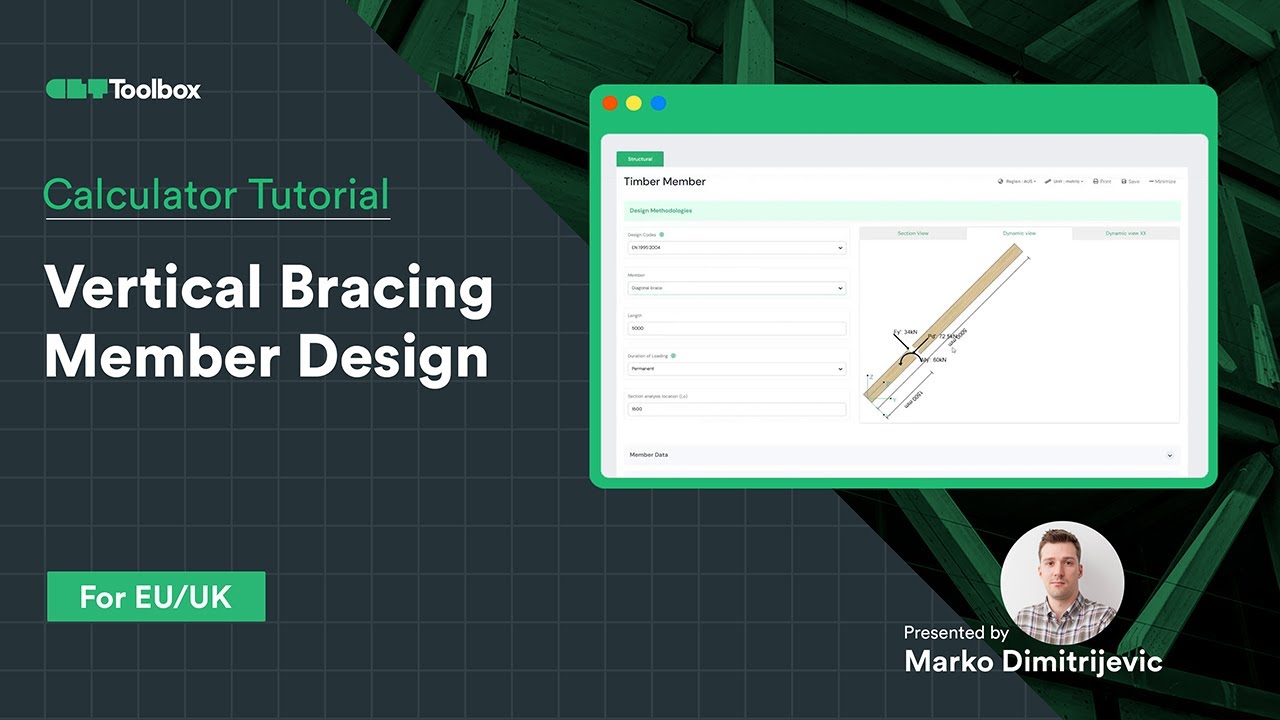
Progettazione di elementi di rinforzo verticali
Scopri come progettare diagonali di rinforzo verticali utilizzando il calcolatore CLT Toolbox Member. Questo video ti guida attraverso l'importazione dei dati di forza da strumenti di analisi esterni, l'identificazione delle forze massime di tensione e compressione e la selezione degli input corretti: classi, sezioni, codici di progettazione e carichi applicati. Ottieni una chiara panoramica dei risultati, comprese le proprietà dei materiali e i controlli di progettazione basati sull'Eurocodice.
Il legno massiccio sta trasformando l'edilizia moderna grazie alla sua impronta sostenibile e a basse emissioni di carbonio, offrendo una valida alternativa ai materiali da costruzione tradizionali. CLT Toolbox è qui per supportarti in ogni fase della progettazione del tuo progetto dei sogni con sicurezza e precisione.
Progettazione della penetrazione delle travi GLT
Il calcolatore di penetrazione delle travi GLT semplifica il processo di progettazione delle travi strutturali con penetrazioni. Le caratteristiche di questo calcolatore sono le seguenti:
Standard di progettazione: conforme all'Eurocodice (prEN 1995:2023) o AS 1720:2010/NZ WDG Ch12.6.
Opzioni di immissione dei materiali: scegli tra l'immissione manuale o un fornitore partner preferito.
Forme di penetrazione: copre penetrazioni di forma rettangolare e circolare fino a cinque penetrazioni.
Tipo di trave: si concentra esclusivamente sulle travi semplicemente appoggiate.
Combinazioni di carico: offre forze di progetto in ingresso. Verifica della resistenza: include controlli integrati per limitazioni geometriche, capacità di tensione, capacità di flessione e capacità di taglio.
Controllo rinforzo: fornisce controlli sulla geometria e sul design del rinforzo delle viti.

Frequently Asked Questions
Does this check Hardwood Glulam?
Yes. You can select Australian Hardwood grades (e.g., GL18, GL21 Vic Ash) which are popular for high-end architectural trusses requiring high strength and stunning appearance.
How do I check fire ratings?
This module covers “Cold” structural design. For FRLs (e.g., 60/60/60), please use our Char Rate Calculator to determine the residual sacrificial timber section.
Can I design curved beams?
This module currently handles straight (prismatic) members. Curved beams require a specialized check for radial tension ($k_{radial}$), which is covered in our advanced geometry module.






 CLT
CLT Dowels
 GLT
GLT Viti
Viti Staffe
 Light-frame