
Dowel & Bolt Design Software for CSA O86:2024
Design complex timber connections to CSA O86-19/24. Analyze Shear, Axial, and Moment actions on multi-bolt groups with automated Limit States Design (LSD) checks.
Engineering Platform for Timber Connections to CSA O86:2024
Canadian timber design is unique in its rigorous treatment of brittle failure modes. While a bolt might yield ductilely, the timber around it can split suddenly—a risk that CSA O86 addresses with complex “Row Shear” and “Group Tear-out” equations.
The SPEC Toolbox Dowel & Bolt Module handles this complexity automatically. Whether you are designing a glulam truss node or a heavy timber beam splice, this tool runs the full CSA O86 Limit States Design (LSD) verification. It optimizes your connection for both ductile yield (steel failure) and brittle fracture (wood failure), ensuring a safe and efficient design.
What This Calculator Does
This module utilizes a dynamic visual engine to optimize dowels, bolts, and steel plates. It automates the iterative checks required by the National Building Code of Canada:

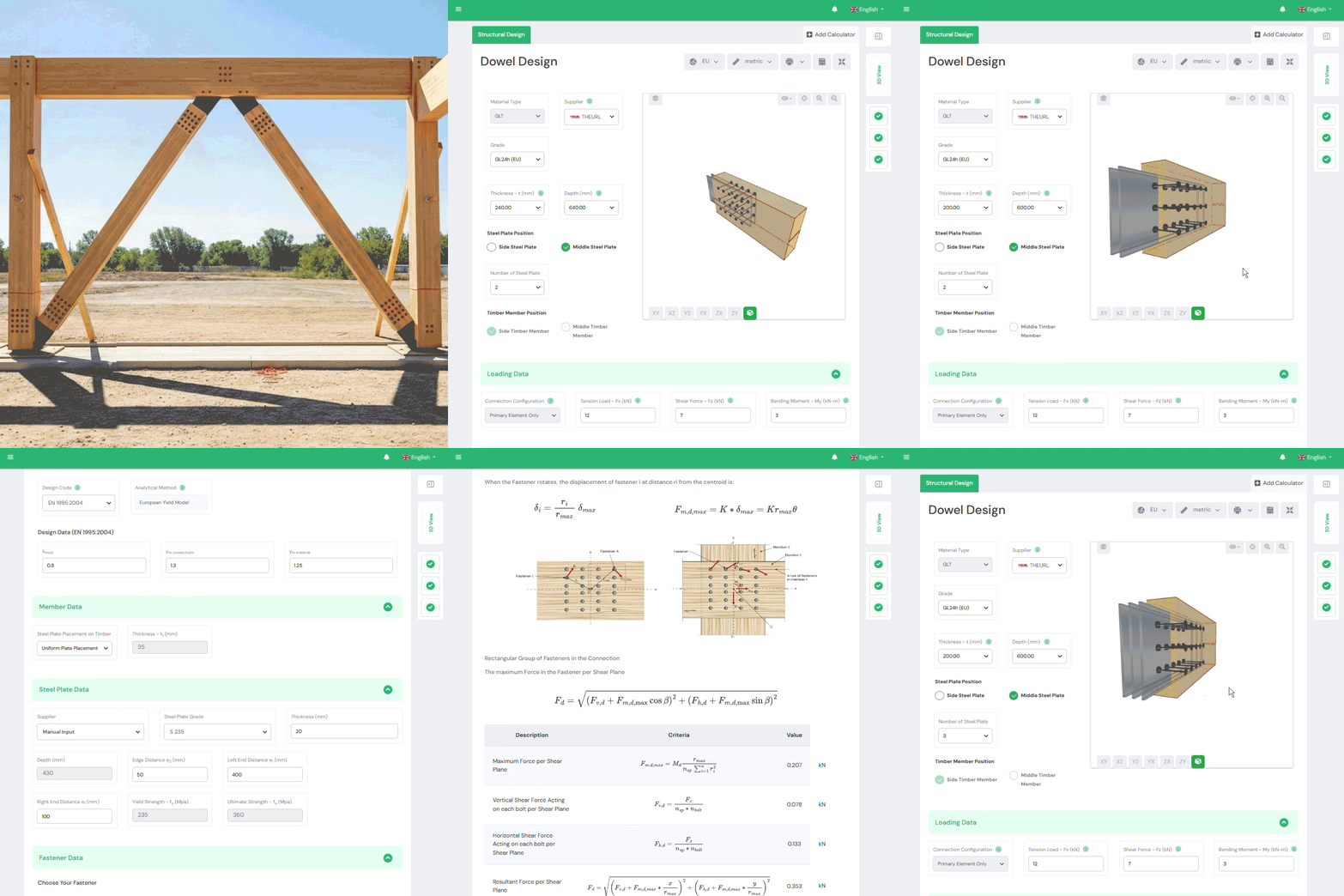
About Dowel & Bolt Connection Design
Technical Guide: Designing to CSA 086: 2024
1. Yield Limit Theory (Automated)
CSA O86 requires checking multiple yield modes to find the “Unit Lateral Strength” ($n_u$).
Our calculator runs the full matrix:
- Mode a, b: Wood embedment failure (Main or Side member).
- Mode d: Fastener yielding with wood crushing.
- Mode e, f, g: Double curvature yielding (Plastic hinge formation).
- Feature: The tool identifies the governing mode. If it’s a ductile mode (steel yield), it allows for a more efficient design than brittle wood failure.
2. Combined Actions (Moment + Shear)
Standard CSA tables don’t tell you how to handle a moment-resisting knee connection.
Our module uses a Rational Analysis (Elastic Method). It resolves the applied Moment, Shear, and Axial forces into a resultant vector for every bolt. It then checks this resultant against the bolt’s capacity at that specific angle to grain (Nr,\theta), ensuring the “corner bolts” don’t fail.
3. The Group Effect (JG)
In a long row of bolts, the load is not shared equally.
The calculator calculates the Group Effect Factor (JG) based on the number of fasteners per row, the stiffness of the members, and the ductility of the connection. This prevents the dangerous overestimation of capacity in large tension splices.
Key Formulas & Parameters
Factored Lateral Resistance (Nr):
N_r = \phi \cdot N_u \cdot n_F \cdot K_D \cdot K_{SF} \cdot K_T
$$
The tool automates the “K-factor” stack:
- 𝜙 (Resistance Factor): Defaults to 0.7 (standard for connections) or 0.8 (for ductile yielding modes).
- KD (Duration): Adjusts for Standard Term (1.0), Short Term (1.15), or Permanent (0.65).
- KSF (Service Condition): Specific to Canada (Dry vs. Wet). Unlike the US/EU, this factors in the specific moisture response of the connection type.
Brittle Failure (PRr, PGr):
CSA O86 requires checking that the wood block doesn’t tear out before the bolts yield.
Row Shear: Checks shear failure along two planes for each row of bolts.
Group Tear-out: Checks the tearing of the whole block of wood surrounding the group.
Frequently Asked Questions
Does this check Steel Plates?
Yes. For Steel-to-Timber connections, the tool checks the Steel Plate Bearing and Tensile Yield capacity, using the relevant CSA S16 (Steel Design) provisions where applicable to the interface.
What about Glulam Rivets?
This module focuses on Dowels and Bolts. Glulam Rivets are a distinct fastener type with their own unique physics and are handled in a separate module (coming soon).
Does it handle "Tight" Geometry?
Yes. If your end distance is less than the standard requirement but within the “minimum” allowed, the tool automatically applies a reduction factor to the resistance, allowing you to squeeze connections into tight spaces.






 CLT
CLT Dowels
 GLT
GLT Screws