
Glulam Beam & Column Design Software
Design Glulam beams and columns to CSA O86. Analyze 24f-E (Douglas Fir) and 20f-E (SPF) grades with automated Limit States Design (LSD) checks.
The New Engineering Platform for Mass Timber In Canada
Glue-Laminated Timber (Glulam) is a staple of Canadian construction, from the expansive roofs of BC hockey rinks to heavy-timber commercial framing in Quebec.
The SPEC Toolbox Glulam Calculator is calibrated for the Canadian engineer. It automates the Limit States Design (LSD) requirements of CSA O86 (Engineering Design in Wood), streamlining the complex application of volume effects (KZ) and stability factors (KL) for standard Canadian species.
What This Calculator Does
This tool performs a comprehensive analysis of Glulam members under gravity and wind loads using the standard Canadian load combinations ($1.25D + 1.5L$). It verifies:

Våra partneruppdateringar
Den snabbast växande plattformen för trävaruspecifikationer
Key GLT Design Capabilities
Design of GLT Beams
Supplier & Code Integration
Effective glulam beam design begins with the correct application of CSA O86:19 timber design provisions and loading conditions defined in the National Building Code of Canada (NBC 2020). Our platform integrates supplier-specific glulam data with CSA design requirements, enabling fast and reliable structural verification of timber beam elements.
Material grades are evaluated using CSA design parameters. The calculator applies Canadian design factors, including service condition, load duration, and creep factors, ensuring compliance with Canadian structural timber design requirements.
Analytical Model for Glulam Beams
Elastic Beam Theory
Glulam beams are analyzed using classical Euler–Bernoulli beam theory, where the beam is modeled as a linear elastic element and plane sections remain plane during bending. This method provides accurate evaluation of internal forces, stresses, and deflections.
Section Properties
The structural behavior is determined from the beam geometry and glulam grade. Important properties such as moment of inertia, section modulus, effective area, and stiffness parameters are automatically calculated to determine member resistance and deformation.
Stability Considerations
Slender beams may experience lateral or torsional instability when subjected to bending. The design model includes effective length and restraint conditions to ensure reliable structural performance under applied loads.
Structural Performance Checks
The calculator evaluates the primary structural limit states according to CSA O86:19 design provisions.
Bending Verification
The maximum bending stress is calculated and compared against the design bending strength of the glulam section.
Shear Verification
Shear stresses within the beam cross-section are verified against the design shear resistance to ensure safe load transfer.
Deflection Verification
Serviceability performance is assessed by evaluating instantaneous and long-term deflections, including creep effects, and comparing them with allowable limits defined by Canadian design practice.
Slenderness Verification
Member slenderness ratios are evaluated to confirm that the beam geometry satisfies stability requirements for the selected loading and restraint conditions.
Design of GLT Column
Supplier & Code Integration
Effective glulam column design requires proper application of CSA O86:19 timber design provisions together with loading conditions defined in NBC 2020. SPEC Toolbox integrates supplier-specific glulam data with Canadian design requirements to enable accurate structural verification of compression members.
Canadian glulam grades such as 20f-EX Douglas Fir-Larch are evaluated using CSA design parameters, including service condition factors and load-duration adjustments.
Analytical Model for Glulam Columns
Elastic Member Analysis
Glulam columns are modeled as linear elastic members following classical structural mechanics principles. Axial compression forces, bending moments caused by load eccentricities, and interaction effects are evaluated using CSA design procedures.
Section Properties
The structural behavior is determined from the column geometry and glulam grade. Key section properties such as moment of inertia, radius of gyration, and section modulus are automatically calculated to determine stiffness and resistance.
Load Eccentricity Effects
Columns frequently experience eccentric loads from connected beams or structural elements. The calculator considers eccentricities in both principal directions, producing bending moments that interact with axial compression during design verification.
Structural Performance Checks
The calculator evaluates the principal ultimate limit state checks for timber columns according to CSA O86:19.
Bending Verification
Bending stresses caused by eccentric loading are checked about both principal axes of the column cross-section.
Compression Verification
Axial compression forces are verified against the design compression strength of the glulam material.
Combined Actions Verification
When axial force and bending occur simultaneously, interaction equations defined in CSA O86 are applied to verify combined stresses.
Buckling Verification
Column stability is evaluated through slenderness ratios, effective length parameters, and CSA buckling resistance factors.
Lateral Torsional Stability
Additional stability verification ensures the column remains stable under combined compression and bending effects.
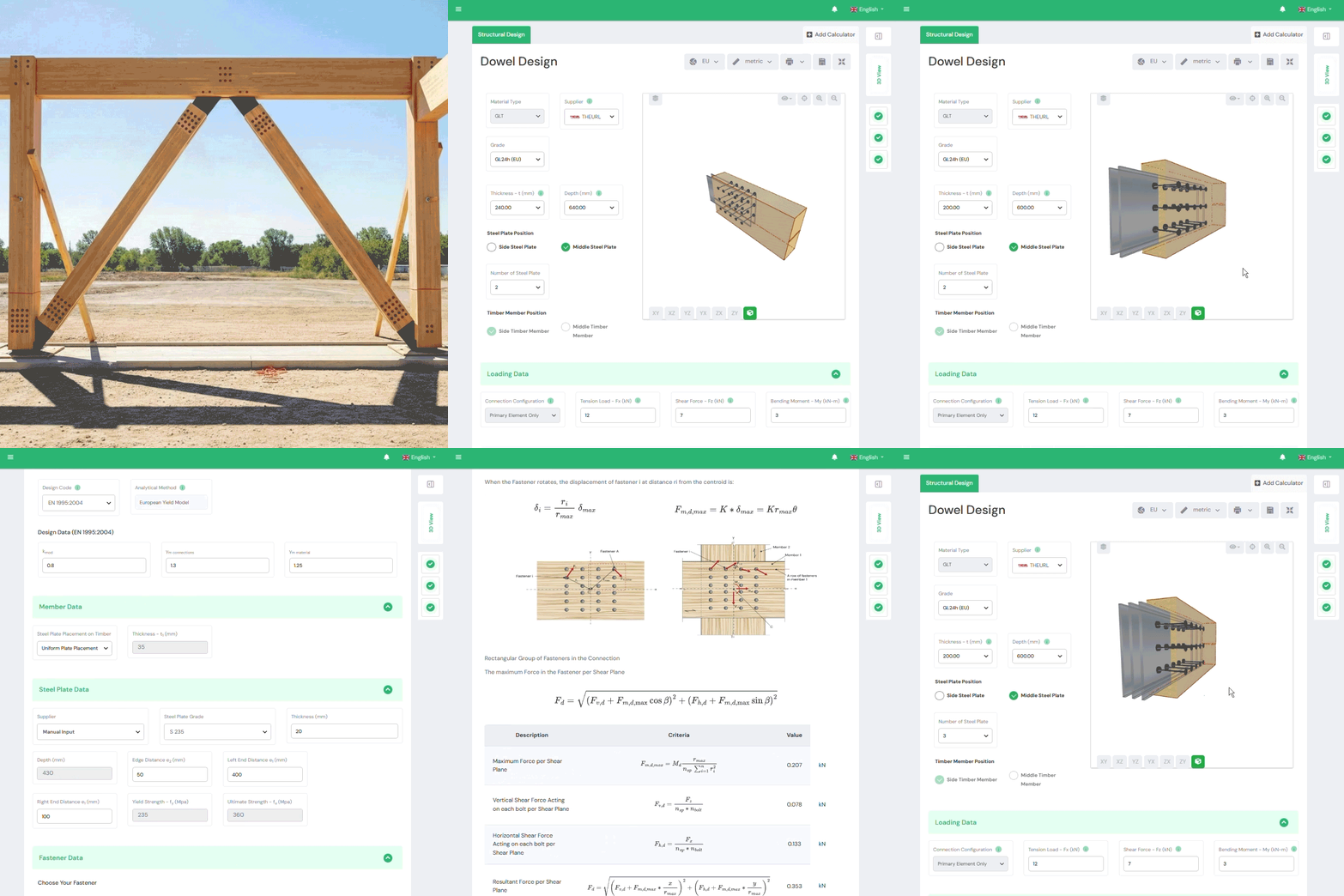
Design of GLT Connections
Advancing Structural Connection Design for Glulam
While CSA O86:19 provides the primary design framework for timber connections in Canada, modern glulam connection design requires detailed modeling of fastener behavior and timber failure mechanisms to ensure safe load transfer.
Advanced Yield Modeling
SPEC Toolbox implements the CSA dowel-type fastener yield equations, derived from Johansen-type yield theory, to evaluate the behavior of dowel-type fasteners in glulam connections.
These models predict the governing fastener failure modes and determine the connection resistance under applied shear and tension forces.
Manufacturer Data Integration
The platform integrates supplier-specific glulam properties, allowing engineers to design connections using real manufacturer material data while maintaining compliance with CSA O86 design provisions.
Simplified Structural Joint Design
SPEC Toolbox streamlines complex connection calculations into a clear and efficient engineering workflow for glulam connection verification.
Supported Connection Type
The Canadian design module currently supports:
Dowel and Bolt Connections
These connections are evaluated according to CSA O86 dowel-type fastener provisions, ensuring proper verification of timber and fastener capacity.
The “Global-Local” Connection Library
SPEC Toolbox allows engineers to combine glulam suppliers with fastener systems, enabling realistic connection design that reflects both material properties and hardware performance.
Universal Fastener Selection
Connections can be designed using dowel-type fasteners such as bolts and dowels, evaluated using CSA connection design equations and adjustment factors including service condition and load duration.
Verified Compatibility
Connection designs can be evaluated using glulam materials from suppliers including:
Mercer Canada and Nordic Structures, as well as user-defined material properties through manual input.
Automated Structural Checks
The calculator automatically evaluates several critical connection verifications:
-
Geometric Check – verification of spacing and edge distance requirements
-
Yielding Resistance – fastener yielding capacity
-
Row Shear Resistance – shear capacity along fastener rows
-
Splitting Strength – resistance against timber splitting
-
Group Tear-Out Resistance – resistance of timber around fastener groups
-
Net Tension Resistance – capacity of the remaining timber section
These automated checks ensure glulam connections meet CSA O86:19 design requirements while maintaining safe load transfer between structural elements.
The Ultimate GLT Design Platform for USA Structural Engineers
If you’re looking to design CLT on your next project, then SPEC Toolbox has you covered!
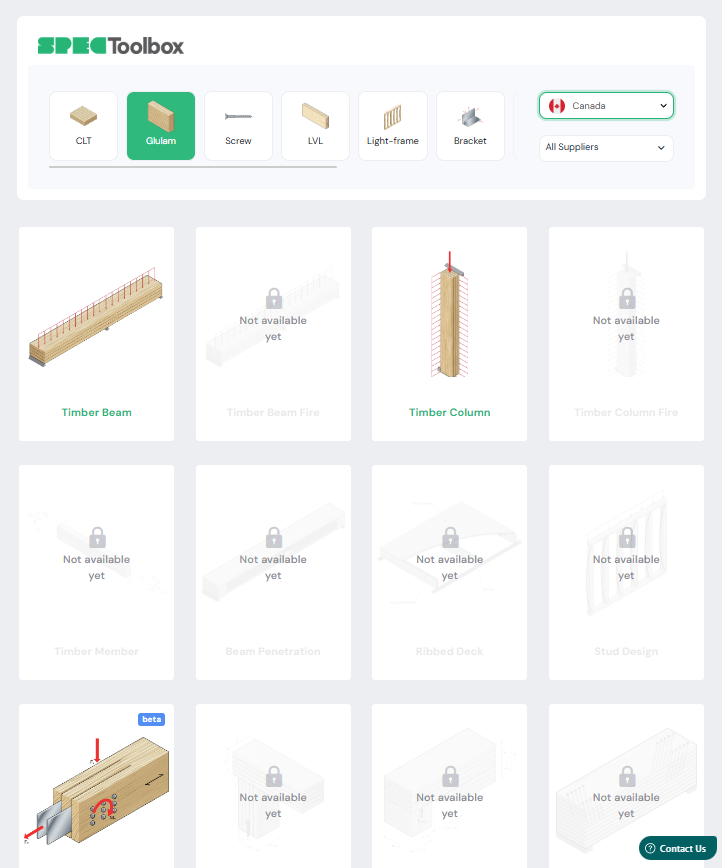






 CLT
CLT Dowels
 GLT
GLT Skruvar